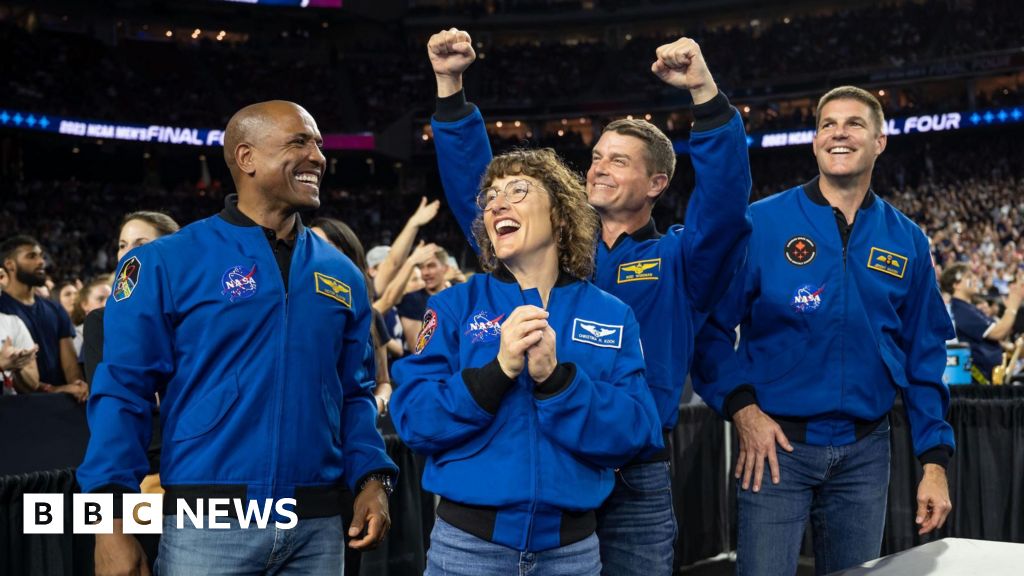
Artemis II will be the first crewed lunar orbital mission in more than 50 years, carrying four astronauts (Reid Wiseman, Victor Glover, Christina Koch, Jeremy Hansen) and testing the pathway for future lunar exploration. The crew includes several firsts if successful: Koch would be the first woman to travel to the Moon, Hansen the first non-American, and Glover the first Black person; personal-item choices underscore the mission's human-interest angle. This is a high-profile programmatic/PR milestone for NASA with negligible direct market impact on public equities or fixed income.
The Artemis II crew’s human narrative—diverse firsts, emotional personal items, and explicit family-facing messaging—is functionally a marketing campaign for sustained public and congressional support for NASA programs. That matters for the next 12–36 months: sustained positive public salience reduces the political volatility premium on NASA budgets, making multi-year procurement awards likelier and accelerating follow‑on commitments (landers, habitation modules, surface logistics) that crystallize contractor revenue streams.
Second-order supply-chain effects favor large, vertically integrated primes and established space‑system suppliers rather than speculative commercial-tourism plays. Expect procurement push toward high‑reliability avionics, RS‑25/upper-stage sustainment and precision robotics (low‑single‑digit billions of incremental contract flow across primes over 2–4 years), which benefits incumbents with flight heritage while crowding out smaller firms that lack proven human‑rated hardware.
Key risks and catalysts are discrete and time‑staggered: a launch anomaly would erode public/political goodwill within days and could prompt re‑prioritization of funds to unmanned science in the following 3–6 months; conversely, a clean mission and strong mainstream media moments will drive Congressional appropriations momentum in the 6–18 month window. Watch FDA‑style technical reviews, GAO cost reports, and appropriation markups as binary catalysts that will re‑price winners/losers faster than long‑term technology narratives.
AI-powered research, real-time alerts, and portfolio analytics for institutional investors.
Request DemoOverall Sentiment
neutral
Sentiment Score
0.05
