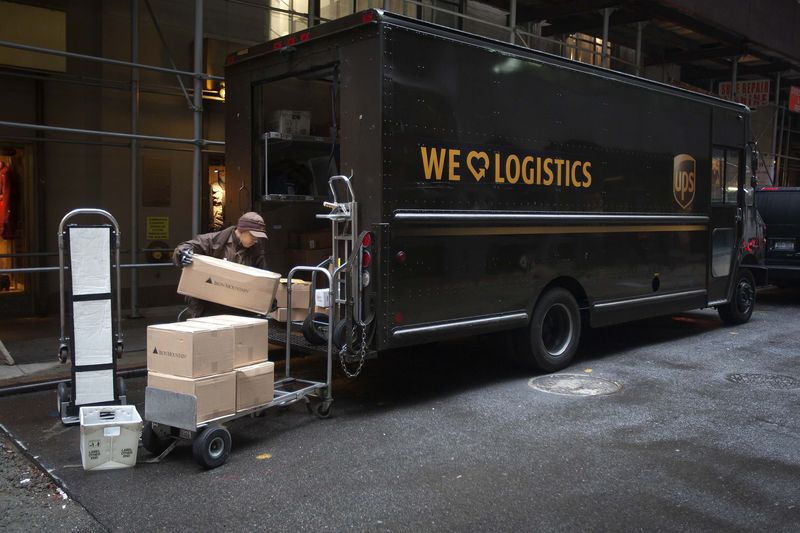
UPS fell 8.21% to $98.74 after Amazon launched Amazon Supply Chain Services, directly competing with UPS across ocean, air, ground and rail freight and targeting third-party shippers UPS needs to replace lost Amazon volume. The move compounds a difficult Q1 2026 backdrop, where GAAP EPS was $1.02, down more than 27% year over year, and follows recent price-target cuts from UBS to $123 and Evercore ISI to $111. Shares hit an intraday low of $98.53, well below the 52-week high of $122.41, as investors reassessed the H2 2026 recovery thesis.
UPS is now getting hit on two axes at once: the market is no longer willing to underwrite the “Amazon replacement volume” story, and the replacement itself may be structurally inaccessible because Amazon is not just a customer loss but a network competitor. The second-order effect is more important than the headline decline: if Amazon starts monetizing excess logistics capacity externally, it can subsidize lower rates across modes, forcing a price reset in parcel, forwarding, and less-than-truckload brokerage where UPS and peers have relied on service premiums and network density.
The near-term loser is UPS, but the broader read-through is more negative for all legacy asset-heavy logistics providers that depend on cyclical shipper volumes to absorb fixed costs. FedEx is exposed through the same pricing pressure, while brokers and smaller 3PLs face a squeeze if Amazon uses bundled fulfillment plus transport to cross-sell lower-cost lanes. The likely second-order winner is not another carrier but Amazon’s enterprise software/logistics stack, because even modest third-party adoption can improve asset utilization and further entrench Amazon as a quasi-infrastructure provider rather than just a retailer.
The timeline matters: this is not a one-day air-pocket if Amazon is serious about externalizing its network; the earnings power impact compounds over quarters as renewal contracts reprice. The main reversal catalyst would be evidence that Amazon’s offering is constrained by service quality, regulatory scrutiny, or low shipper adoption, which could stabilize sentiment in 1-2 quarters. Absent that, the market is likely to keep discounting UPS’s H2 margin recovery until there is proof of volume replacement and pricing discipline.
The contrarian angle is that the selloff may already be pricing in a worse-case margin-reset scenario before adoption data exists. If Amazon’s network is still operationally optimized for its own dense lanes, outside-buyer service levels may disappoint, limiting the threat to premium freight and leaving the move overdone in the medium term. That creates a tactical setup for relative-value trades rather than outright directional longs until we see whether Amazon can convert capacity into durable third-party revenue.
AI-powered research, real-time alerts, and portfolio analytics for institutional investors.
Request DemoOverall Sentiment
strongly negative
Sentiment Score
-0.63
Ticker Sentiment
