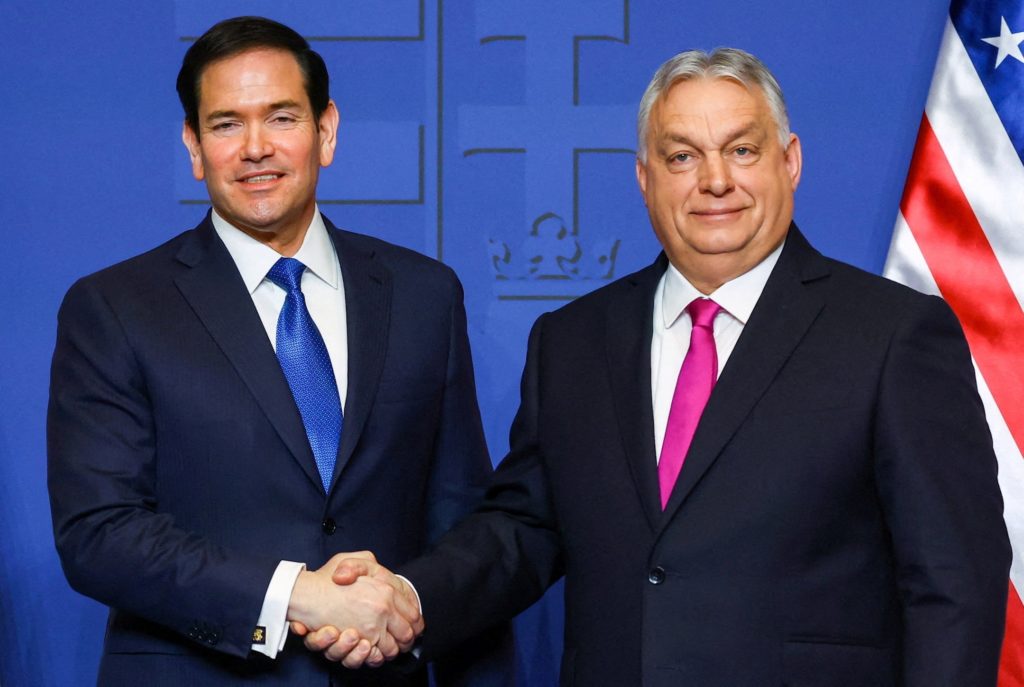
U.S. Secretary of State Marco Rubio visited Budapest and publicly endorsed Hungary's far-right Prime Minister Viktor Orbán as he seeks a fifth term, despite Orbán's close ties to Vladimir Putin and Hungary's refusal to reduce Russian oil purchases — a policy for which the Trump administration has granted a sanctions exemption. Rubio's Munich speech aimed to reassure allies even as European leaders signal moves to "de-risk" dependencies by diversifying energy, trade and defense relationships after recent transatlantic strains. Hedge funds should monitor potential effects on European energy markets, sanctions dynamics and political risk in Hungary ahead of the election, plus any implications for defense spending and broader Europe-U.S. strategic alignment.
Market structure: A U.S. diplomatic tilt toward illiberal EU actors and European talk of “de‑risking” the U.S. implies a re‑rating of defense, energy‑security and infrastructure suppliers versus globalized consumer/discretionary winners. Winners: LNG exporters, European and U.S. defense primes, terminal builders and nuclear/renewables developers; losers: firms reliant on seamless U.S.–EU policy coordination (some defense subcontractors tied to U.S. export licenses) and Russian‑dependent midstream players. In cross‑assets expect upward pressure on European gas/LNG forwards, higher credit spreads on small EU sovereigns if fiscal backstops grow, modest safe‑haven bids in USD and USTs in overnight risk episodes, and elevated volatility in EUR and energy futures over 1–12 months.
Risk assessment: Tail risks include an EU–US policy schism that fragments procurement rules (3–10% revenue hit for contractors dependent on transatlantic programs) and a Russian energy squeeze that spikes TTF/Title transfer prices by 20–50% in an extreme winter scenario. Immediate (days): headline volatility and FX moves; short‑term (weeks–months): LNG offtake/contract re‑routing and defense contract auctions; long‑term (quarters–years): structural capex in terminals, nuclear and sovereign defense budgets (potential +10–20% incremental EU defense spend over 1–3 years). Hidden dependency: semiconductor and avionics supply chains (single‑sourced US tech) that can bottleneck European rearmament.
Trade implications: Core trades are long LNG exporters (Cheniere LNG) and select defense primes (RTX, LMT or BAESY ADR) sized 2–3% each, with 6–12 month targets of +25–40% if European demand firm; construct 6–12 month call spreads to cap premium spend. Hedge currency and policy fragmentation risk by buying a 6‑month EUR put spread sized to hedge 3–4% of international equity exposure, with strike ~5% below spot; reduce duration in German sovereigns by ~30% via short Bund futures over next 3 months to price in higher fiscal deficits. Pair trade: long BAESY (European defense) vs short discretionary retailer ETF XLY (or equivalent European consumer discretionary) to capture rotation into security capex.
Contrarian angles: Consensus treats this as political noise; it is a catalytic signal accelerating capital reallocation: infrastructure lead times mean winners are visible now (terminal builders, EPC contractors, heavy electrical equipment) while stocks have yet to fully price multi‑year demand (possible 10–30% underpricing). Market may be underpricing the probability that Europe adopts independent procurement rules (benefitting EU domiciled primes) and overpricing short‑term diplomatic reconciliation; worst outcomes (nuclear proliferation talk, sanctions divergence) would be disruptive but create asymmetric upside for diversified defense and energy infrastructure exposure.
AI-powered research, real-time alerts, and portfolio analytics for institutional investors.
Request DemoOverall Sentiment
mildly negative
Sentiment Score
-0.25
