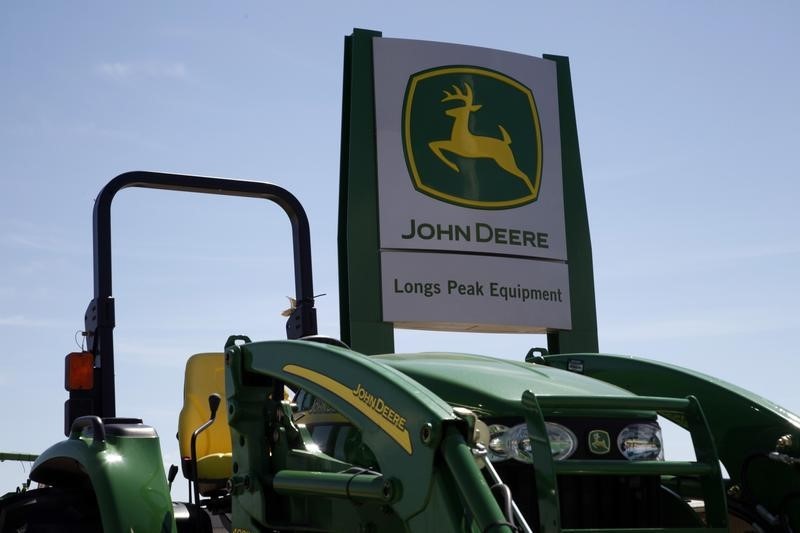
Jefferies upgraded Deere & Company to Hold from Underperform while keeping its $550 price target unchanged after the stock fell ~15% from mid-February highs. The firm models a 75% revenue recovery from the 2026 trough to the next cycle peak (65% volume growth, 10% pricing) with 35% incremental margins and applies a 15x peak earnings multiple to derive the $550 PT. Jefferies retained a cautious macro view—projecting a prolonged trough through 2026, noting 30 months of negative high-horsepower sales, volumes down >40% since the 2023 peak, and production/precision volumes seen falling another 10–15% in fiscal 2026; USDA expects farm income to drop ~15% in 2026. Analyst also flagged that continued Iran conflict could raise fertilizer and fuel costs, affecting farmer economics and commodity dynamics over the longer term.
Deere’s pullback is creating a bifurcated opportunity set across equipment OEMs, aftermarket/auction platforms, and fertilizer/logistics suppliers. The core dynamic is timing: OEM equity is pricing a multi-year trough in farmer capex while fertilizer and fuel volatility create asymmetric short-term upside for input producers and transport carriers. Dealers and captive finance arms sit in the middle — credit stress there would amplify downside to OEMs via inventory build-up and parts/residual-value impairment, but a weather- or policy-driven spike in crop prices would reverse that within a single planting season.
Second-order winners include precision-ag software and data monetization players that can extract recurring revenue even if new-equipment volumes are muted; platforms that convert ownership to usage (leasing/rental marketplaces) also gain as farmers delay purchases. Conversely, smaller competitors with weaker balance sheets and high exposure to high-horsepower segments will underperform if the trough persists and used-equipment flows accelerate, pressuring residual values. Geopolitical tail risk (fertilizer/logistics disruption from MENA conflict) is a force multiplier — it can lift input profits and crop prices quickly, but farm-level cashflow improvement will lag and be uneven across geographies.
Key catalysts to watch by horizon: days-weeks — RIN policy, fertilizer export bans, and insurance/planting weather headlines; months — USDA income updates, spring planting progress, and captive finance delinquencies; years — cycle peak visibility driven by commodity price structural shifts, adoption of precision recurring revenue and used-equipment market normalization. The consensus underweights Deere’s durable software/data moat as a differentiated source of margin recovery at the next peak; that’s the contrarian lever if you believe capex returns are more front-loaded into high-productivity customers rather than broad cyclical restocking.
AI-powered research, real-time alerts, and portfolio analytics for institutional investors.
Request DemoOverall Sentiment
mixed
Sentiment Score
0.05
Ticker Sentiment
