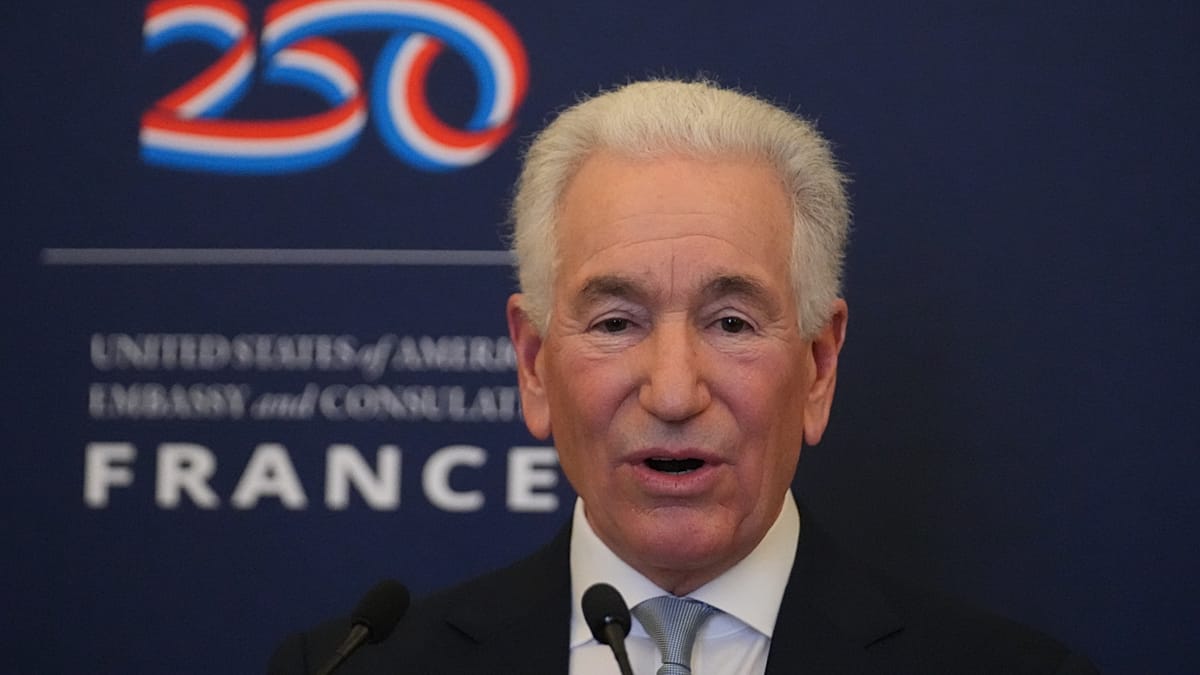
France's foreign ministry has barred US Ambassador Charles Kushner from direct access to government ministers after he failed to attend a summoned meeting to explain a US State Department repost blaming left-wing militants for the death of 23-year-old far-right activist Quentin Deranque following clashes at a 12 February Lyon protest. Foreign Minister Jean-Noël Barrot said the move reflects a failure to respect ambassadorial duties; Kushner may continue other diplomatic functions but will face restricted access. The incident, and a prior no-show in August over a letter to President Macron, heightens bilateral tensions and political polarization in France ahead of next year’s presidential election, though it is unlikely to have material market effects.
Market structure: The immediate market winner is the USD/safe-haven complex (USD, CHF, gold) on a small risk-off; losers are France-centric assets (iShares MSCI France EWQ, French banks BNP.PA, ACA.PA) which can underperform European peers by 1–3% in the next 1–4 weeks as political friction raises a country-specific risk premium. Cross-asset: expect EUR/USD downside pressure of ~0.5–1% in days, a 5–15bp widening of France OAT-Bund spreads in a stressed scenario, and marginally higher short-dated volatility for French equity options vs. pan-European indices.
Risk assessment: Tail risks (low probability, high impact) include an escalatory diplomatic cycle ahead of France’s election that widens OAT-Bund by 10–25bps and lifts French bank CDS by 10–30bps within 1–3 months. Immediate (days) effects are FX/eq beta moves; short-term (weeks) are spread and flows; long-term (quarters) are political-policy shifts affecting regulation and fiscal stance if the incident influences voter sentiment. Hidden dependency: this shock compounds existing election uncertainty — a re-rating of French domestic-exposed names would be amplified if polls shift toward anti-EU or protectionist candidates.
Trade implications: Direct play: small, time-boxed tactical short on EWQ or put-buying for 2–8 weeks; pair-trade long Germany (EWG) / short France (EWQ) to capture relative widening. Options: buy a 3-month EURUSD put spread (1% vs 3% OTM) sized to 0.5–1% portfolio risk; consider buying 1–2% GLD as convex geopolitical hedge. Entry: within 48–72 hours for FX/eq; exit by 3 months or if EUR moves >1.5% or OAT-Bund >12bps.
Contrarian angles: Consensus treats this as transient diplomacy; what’s missed is amplification via election season — a sustained political backlash could impose a 5–10% valuation haircut on small/mid French domestics over 6–12 months, not just days. Historical parallels (minor US-EU spats) often mean-revert in weeks, so size positions small and favor option structures or relative-value trades to avoid being run over if mean reversion occurs. Unintended consequence: over-shorting France could backfire if Paris uses provocation to consolidate domestic support, causing short-squeeze in thinly traded French midcaps.
AI-powered research, real-time alerts, and portfolio analytics for institutional investors.
Request DemoOverall Sentiment
moderately negative
Sentiment Score
-0.25
