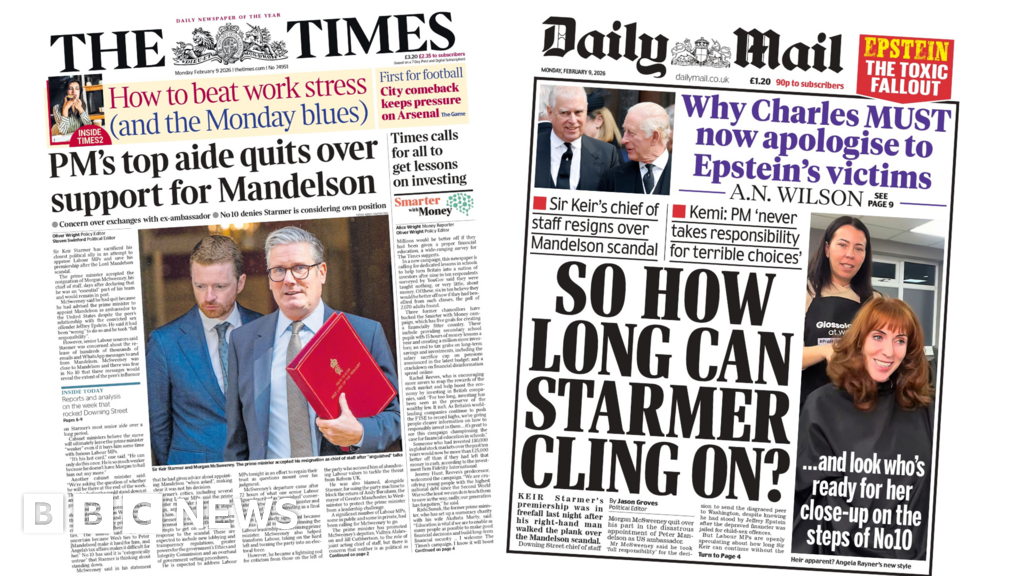
Prime Minister Keir Starmer's chief of staff Morgan McSweeney resigned after taking "full responsibility" for advising Mandelson's appointment amid revelations about Lord Mandelson's past relationship with Jeffrey Epstein and a police inquiry into alleged misconduct and leaked government information. The resignation exposes a Labour leadership crisis that increases short-term political risk for the UK government and could raise volatility and policy uncertainty for UK-focused assets and investors.
Market structure: Political turmoil centered on the prime minister's office increases idiosyncratic risk for UK‑domiciled, domestically focused equities (FTSE 250, small caps, retail, regional banks) and raises a short‑term risk premium on sterling and gilts. Exporters and multi‑national FTSE 100 names (large pharma, energy, miners) should be relatively insulated because >50% revenue is USD/EM‑linked, supporting market‑cap concentration in a defensive few; expect rotation into FTSE‑100 heavyweights within 1–6 weeks. Pricing power shifts toward globally diversified blue‑chips while domestics face rerating risk of 5–15% if political uncertainty persists beyond one quarter.
Risk assessment: Tail risks include a forced leadership contest or snap election (10–25% probability over 6 months) that could widen UK 10y gilt yields by 15–50bps and weaken GBP by 3–8% vs USD in acute episodes. Immediate (days) volatility will be headline‑driven; short‑term (weeks/months) risk concentrates in credit spreads of regional banks and consumer discretionary earnings; long‑term policy risk (quarters) hinges on whether Labour reasserts fiscal/immigration discipline. Hidden dependencies: market impact is amplified if police/legal probes expand to cabinet members or major trade envoys, triggering policy paralysis and delayed corporate approvals.
Trade implications: Favor relative‑value longs in large exporters versus shorts in domestic cyclicals: practical trades include overweighting FTSE‑100 exporters via EWU or selective longs in AZN (AstraZeneca) and SHEL (Shell) while shorting Next (NXT.L) and FTSE‑250 exposure via futures or short ETFs for 1–3% book risk. Use FX and rates derivatives for cheap insurance: buy 1–3 month GBPUSD put spreads (eye strikes 1.20/1.15) and consider 3–6 month steepener protection on UK 10y (receivers/long gilts) if yields breach +20bps from current.
Contrarian angles: Consensus expects broad UK sell‑off; that overstates domestic exposure of market cap—FTSE 100 will likely outperform FTSE 250 by 5–12% if uncertainty lasts one quarter, creating a profitable pair trade (long UKX exporters, short FTMC domestics). Market may underprice quick resolution scenarios: if PM stabilizes within 2–4 weeks, GBP could rebound 2–4% and domestic cyclicals snap back; keep options sized to capture asymmetric outcomes. Historical parallels (minor leadership scandals in stable governments) suggest 50–70% of initial market moves reverse within 1–3 months — size positions accordingly.
AI-powered research, real-time alerts, and portfolio analytics for institutional investors.
Request DemoOverall Sentiment
moderately negative
Sentiment Score
-0.45
