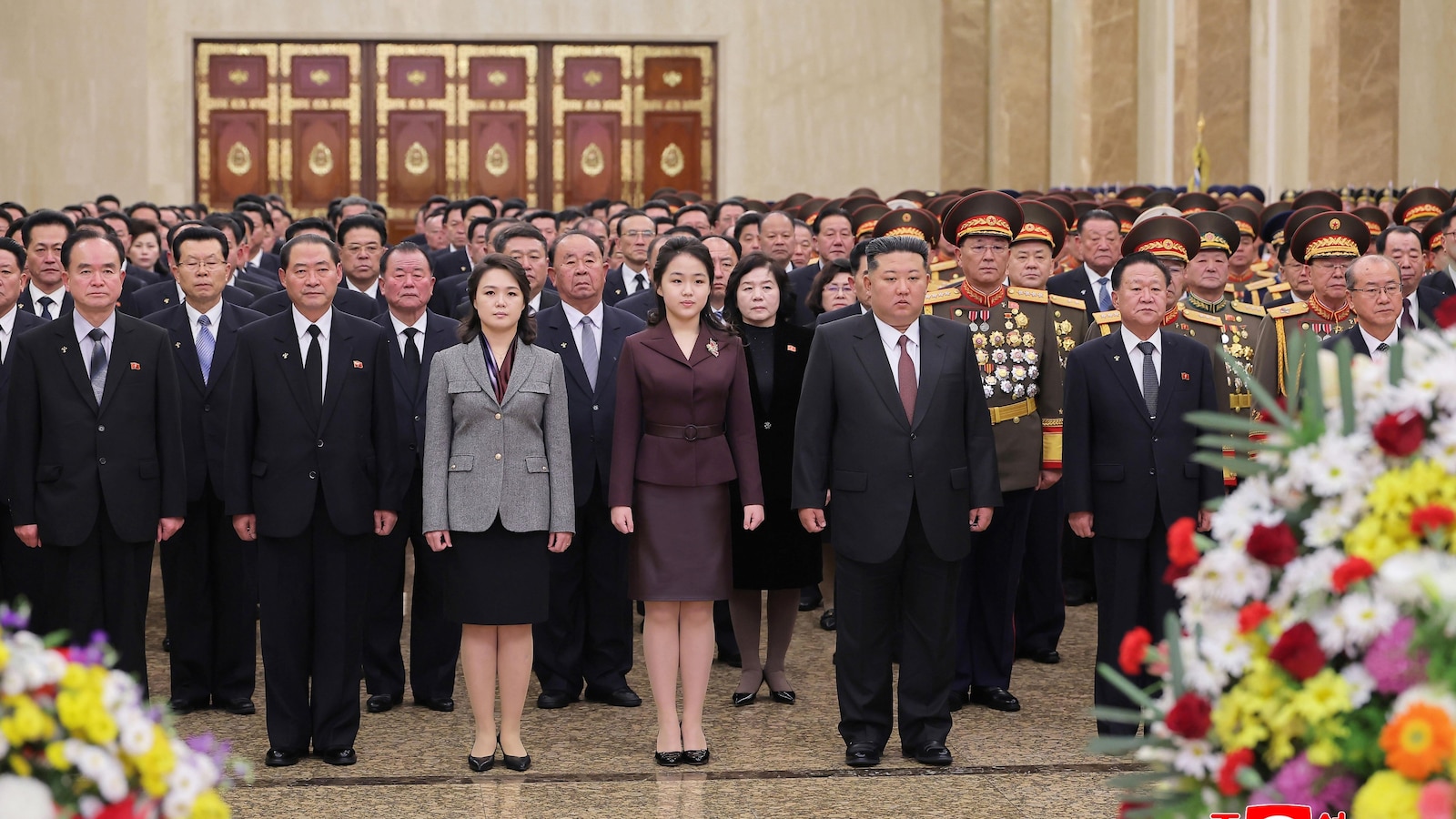
Kim Jong Un's teenage daughter, reportedly Kim Ju Ae (about 13), made a public New Year's Day visit to the Kumsusan Palace of the Sun, a ceremonial display experts view as boosting her status as a potential heir. South Korea's NIS says she is likely the successor and the visit precedes a Workers' Party congress expected in January or February, signaling a politically orchestrated move to shore up dynastic legitimacy; this raises geopolitical and succession risk for Korea-focused investors but is unlikely to produce immediate market-moving financial effects.
Market structure: The public introduction of Kim Ju Ae increases the perceived probability of a managed dynastic succession, reducing one class of geopolitical tail-risk (sudden leadership vacuum) but raising the odds of short-term signaling (parades, tests) around the Workers’ Party congress (likely Jan–Feb). Direct beneficiaries are defense & ISR suppliers (Lockheed LMT, Northrop NOC, RTX, ETF ITA) and traditional safe-havens (gold GLD, USD, JPY); losers are Korea-specific risk assets (EWY, KRW, Korean sovereigns) if rhetoric or missile activity spikes. Cross-asset flows are likely modest but directional: small safe-haven inflows lift gold and Treasury prices; local FX volatility (KRW moves ±2–4%) and EM risk premia may widen.
Risk assessment: Tail risks include a provocative missile salvo or clandestine escalation triggering sanctions or military exercises (low-probability but market-moving), and a succession stumble that sparks internal purges disrupting regional trade. Time horizons: immediate (days) — market wobble around any New Year/party events; short-term (30–90 days) — potential tactical drills/tests; long-term (6–24 months) — regime continuity may normalize risk premia or institutionalize succession. Hidden dependencies: China’s tolerance and South Korea/US joint military posture are the main amplifiers; watch Beijing’s diplomatic signals as a force-multiplier.
Trade implications: Tactical long-defense (LMT, NOC, RTX or ITA) sized 1–3% NAV with 3–6 month horizons and staggered entries; short EWY (or buy EWY 30–60 day put spreads) as a relative-value hedge sized 0.5–1% NAV for expected volatility around the congress. Options: buy 3-month call spreads on ITA or LMT to cap cost, and buy 30–90 day put spreads on EWY (strikes 2–4% OTM) to monetize event risk. If KRW weakens >3% vs USD or a medium-range test occurs, increase defense/gold exposure by +1–2% and tighten stop-losses on EWY.
Contrarian angle: Consensus expects instability; what’s missed is that visible succession grooming can decrease long-term tail-risk and political unpredictability, which would be bearish for premium-priced defense names if it becomes a durable normalization (12–24 months). Reaction is likely underdone in gold and overdone in single-country Korea shorts if no provocations occur within 90 days — monitor actual missile/test cadence rather than rhetoric. Historical parallels (e.g., post-succession stabilization in other autocracies) suggest scaling back event hedges after 3–6 months if no escalation materializes.
AI-powered research, real-time alerts, and portfolio analytics for institutional investors.
Request DemoOverall Sentiment
neutral
Sentiment Score
0.00
