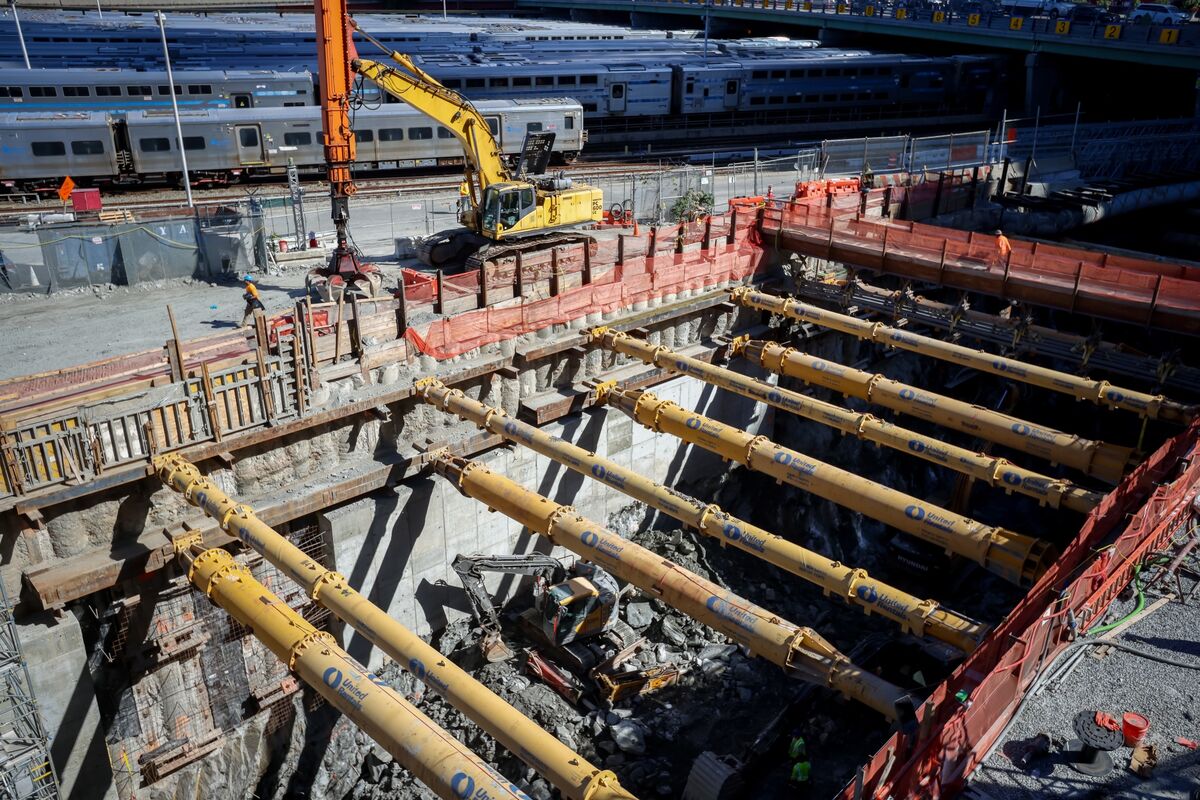
The Trump administration has opened discussions with New York officials to determine whether the Hudson River tunnel and Second Avenue Subway projects comply with new federal diversity rules, a review that could lead the U.S. Department of Transportation to release roughly $18 billion in previously paused funding. The Metropolitan Transportation Authority said it received federal questions and has about 30 days to respond, creating conditional upside for contractors, transit funding flows and New York municipal project financing if the projects are certified compliant.
Market structure: Immediate winners are large national engineering and construction contractors and equipment/material suppliers that can absorb compliance costs — think Jacobs Solutions (J), AECOM (ACM), Caterpillar (CAT), Vulcan Materials (VMC). Losers are smaller NYC-area subcontractors, local developers and lenders to transit-oriented projects if the $18B stays paused; released funds would likely bid up regional steel/aggregate and labor demand by an incremental 5–15% over baseline construction inflation. Cross-asset: muni spreads on NY speculative paper should tighten if funds are released; industrial commodity prices and select mid-cycle cyclicals would see upward pressure; Treasury 10Y could drift -5–15bp on visible federal capex flow.
Risk assessment: Tail risks include a DOT finding of non-compliance that withholds funds >12 months, litigation that redirects funds, or an election-driven policy reversal — each could knock 2025 regional construction revenues 10–25%. Immediate horizon: 30 days for MTA response; short-term (90 days) for DOT ruling; long-term (12–36 months) for construction spend realization. Hidden dependencies: compliance may force higher DBE/prevailing wage costs (5–10% hit to project margins), advantaging firms with established compliance teams.
Trade implications: Direct plays favor 1–3% tactical longs in J and ACM (3–12 month horizon) and 1–2% in CAT or VMC for materials exposure; buy 3-month call spreads on J/ACM if implied vol cheap, cap risk to premium. Pair trade: long large-cap contractors (J) vs short NYC-focused REITs (SLG, VNO) that suffer from delays. Fixed income: overweight high-quality NY muni exposure (MUB as interim proxy) to capture spread tightening if funds release.
Contrarian angles: Consensus assumes funds will flow; markets underprice compliance-driven margin compression — released capital could increase topline but trim EBITDA by 5–10%, favoring scale over smaller margin players. Historical parallel: Gateway/Big Dig cycles showed initial contractor rallies that later normalized as costs rose. Action: favor firms with documented DBE/compliance records and balance-sheet strength rather than small regional contractors.
AI-powered research, real-time alerts, and portfolio analytics for institutional investors.
Request DemoOverall Sentiment
neutral
Sentiment Score
0.10
