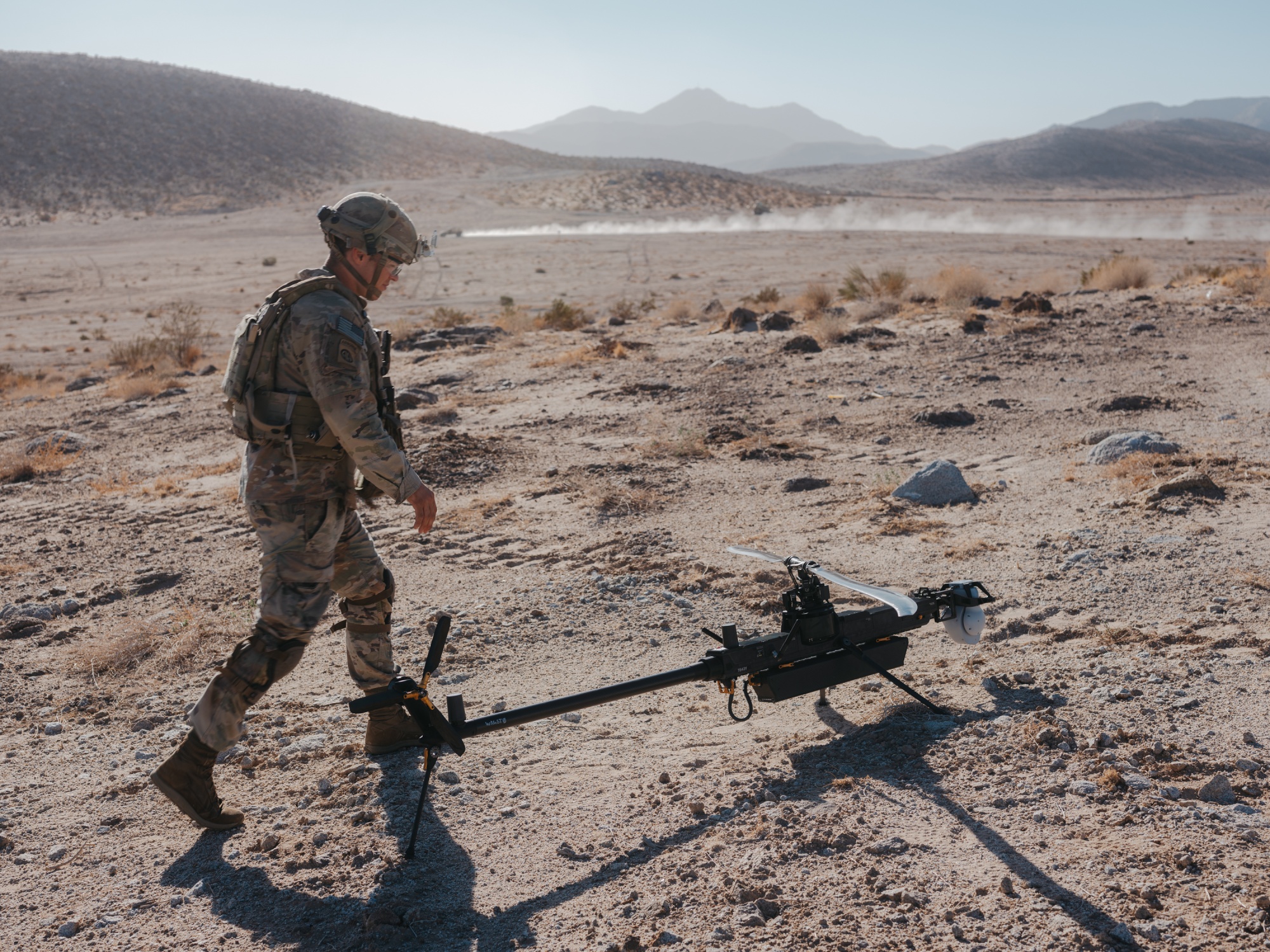
U.S. Army exercises at the National Training Center and the Joint Pacific Multinational Readiness Center tested large-scale integration of commercial and military drones (Anduril Ghost‑X, Performance Drone Works C‑100, Skydio, Parrot, EchoMAV, FlightWave) alongside Palantir’s Maven Smart System and field 3‑D printing (25th Infantry Division’s Lightning Labs Kestrel, which dropped a live weapon on Oct. 17). The drills highlighted operational frictions — battery logistics, software glitches, detection risks from social media — even as leaders push procurement flexibility, additive manufacturing, and AI-assisted planning to accelerate fielding of autonomous systems. Results matter for defense procurement and commercial drone vendors as the Army reshapes tactics for Indo‑Pacific scenarios and scales drone-on-drone engagements.
Market-structure: Modular, commercialized procurement and mass drone deployment favor software/AI integrators (Palantir PLTR), battery/portable power suppliers, sensors and COTS drone OEMs while compressing margins for legacy monolithic prime programs. Expect mid-single-digit market-share gains for flexible vendors within 12–36 months and rising spot demand for lithium/battery components driving commodity pressure for 12–24 months.
Risk assessment: Tail risks include a major kinetic escalation that reorients budgets (upside for primes but disrupts supply chains), sudden export controls on key components, or AI/regulatory constraints that slow fielding; probability moderate over 1–3 years. Immediate (days–weeks) volatility will track exercise reports and DoD announcements; structural shifts play out over multiple budget cycles (12–48 months).
Trade implications: Tactical winners are PLTR (software/AI/mapping), battery/miner ETFs (LIT, ALB exposure), and aerospace & defense ETFs (ITA/XAR) with selective call-spread option trades on large primes to limit premium. Position sizing should be small (1–4% per idea) with explicit stop-losses and event-driven add-ons tied to contract announcements or FY budget milestones in the next 3–12 months.
Contrarian angles: The market underappreciates sustainment/logistics (mobile power, 3D-printing parts — SSYS/DDD exposure) and electronic-warfare/counter-UAS winners; conversely, the hype around point solutions may be overdone if integration costs and OPSEC failures emerge. Historical analog: rapid COTS adoption in early 2000s benefited aftermarket/sustainment firms more than new platform vendors; expect similar second-order winners here.
AI-powered research, real-time alerts, and portfolio analytics for institutional investors.
Request DemoOverall Sentiment
neutral
Sentiment Score
0.12
Ticker Sentiment
