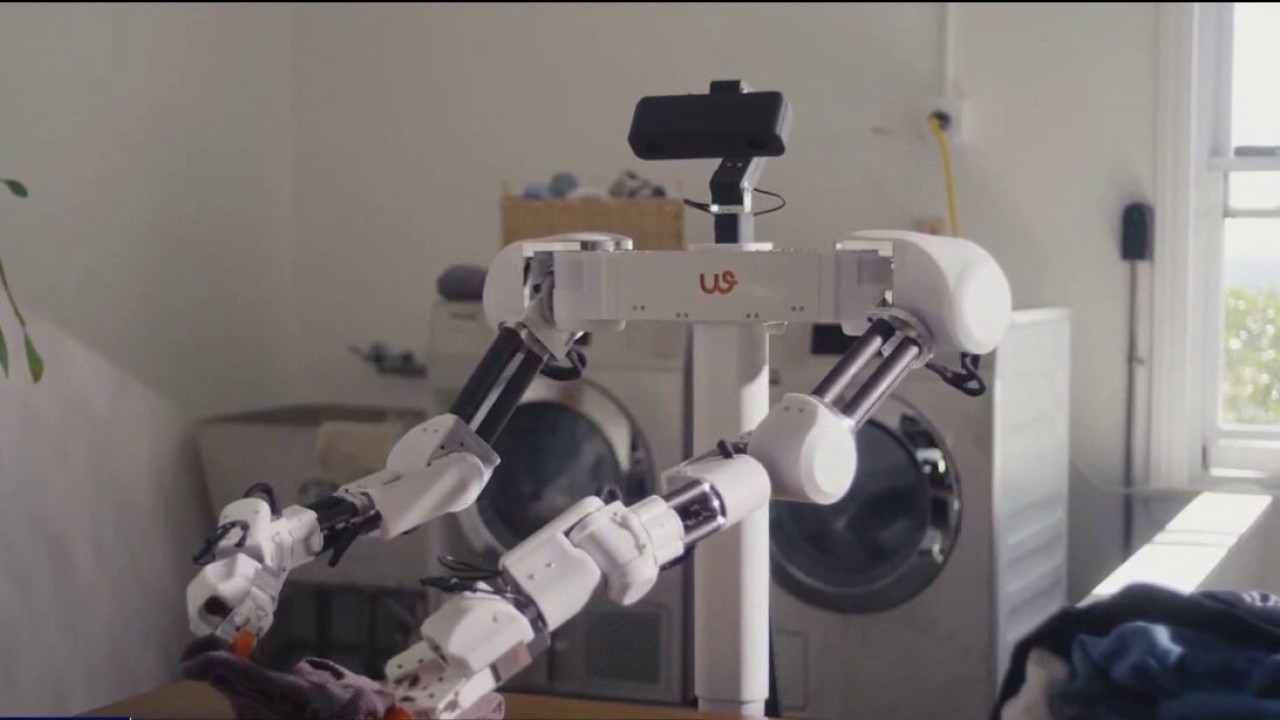
Weave Robotics has begun taking orders for 'Isaac O,' a household laundry-folding robot priced at roughly $8,000 or $450 per month, with Bay Area deliveries starting this month. The unit folds most clothing, towels and pillowcases in about 30–90 minutes, requires approximately 6'x5' of space, a stable internet connection, and installs in an afternoon, though it cannot yet handle large blankets or bedsheets. Early customer testimonials are positive, but the regional rollout and lack of broader distribution limit near-term revenue and market impact despite signaling growing consumer automation demand.
Market structure: This product primarily benefits edge-AI and sensor suppliers (NVDA, ON, STM), smart-home platforms (AMZN, GOOG) and logistics/aftermarket service providers if scale arrives; small incumbent impact on appliance OEMs (WHR) and laundromat services is likely concentrated and slow given $8k list / $450/mo pricing. Competitive dynamics favor ecosystems (voice, payment, repair) over standalone hardware — winners will be firms that provide integration, distribution and cloud inference, not just the robot OEM. Supply/demand: near-term demand is demand discovery (Bay Area pilot) and constrained by size (6'x5') and throughput (30–90 min/load); long-term demand could grow if price falls toward <$2k and throughput improves to <20 min/load.
Risk assessment: Tail risks include product-liability litigation, data/privacy rules (state-level CA/FTC scrutiny) and hardware recalls that could wipe out startup equity; supply-chain shocks for actuators/sensors would raise costs >20%. Time horizons: days–weeks: sentiment/PR spikes in local markets; 3–12 months: regional rollouts and partnerships; 2–5 years: potential meaningful penetration if price/size/throughput improve by ~3x. Hidden deps: subscription churn, spare-parts economics, integration with voice platforms and regulatory approvals. Catalysts: major retail/fulfillment partnership, price cut to <$2,000, or negative press/recall.
Trade implications: Direct plays — overweight semiconductor/AI names (NVDA) and motor/driver suppliers (ON) for 3–12 months; tactically buy 6–12 month call spreads to express upside while capping cost. Pair trade — long ON (1% NAV) vs short WHR (1% NAV) for 3–9 months to capture relative upside from component demand vs appliance margin pressure. Options — use defined-risk 9–12 month call spreads on NVDA or AMZN sized 0.5–1% NAV; avoid naked options on high-beta small robotics names. Sector rotation — shift 1–3% from traditional household appliance exposure into semiconductors and smart-home platform exposure.
Contrarian angles: The market may overstate near-term TAM; current product economics (time per load, footprint, $8k price) suggest adoption will be highly elastic and clustered in high-income urban pockets. Historical parallel: Roomba took ~7–10 years to reach mass market after price fell and retail channels scaled; if Weave cannot lower price below ~$2k in 24–36 months it risks being a niche. Unintended consequences include warranty/repair costs and reputational losses if garments are damaged, which could materially increase lifetime cost-of-service and limit subscription retention below 50% annually.
AI-powered research, real-time alerts, and portfolio analytics for institutional investors.
Request DemoOverall Sentiment
mildly positive
Sentiment Score
0.25
