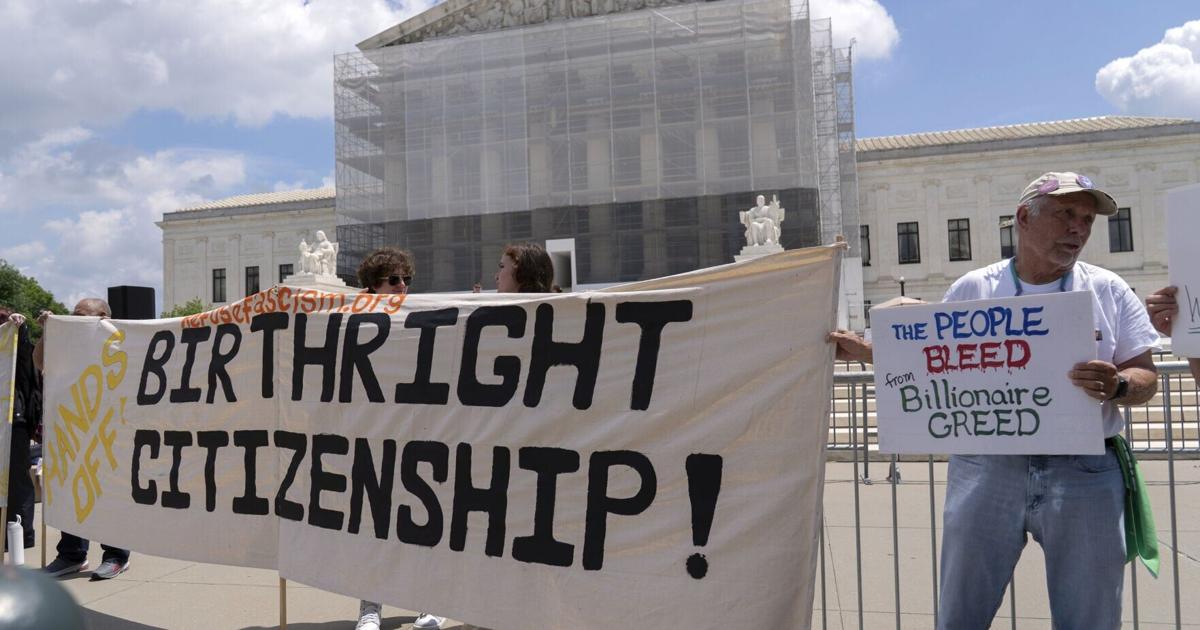
The Supreme Court will hear challenges to President Trump's Jan. 20, 2025 executive order to deny birthright citizenship under the 14th Amendment and an 86-year-old federal law. Research cited in the article estimates the order could affect more than 250,000 U.S.-born infants per year; lower courts have called the order likely illegal and kept it on hold, meaning immediate market impact is minimal though immigration policy changes could have downstream effects on affected sectors.
The Supreme Court fight is primarily a political-legal volatility driver rather than a fundamental shock to earnings — expect headline-driven intraday moves around the argument and ruling dates, and a sustained re-pricing of regulatory/executive-power risk into the 2026 election cycle. If the Court upholds broad executive authority here, it creates a playbook for future unilateral policy changes, increasing policy tail risk for sectors sensitive to immigration, labor and talent flows; conversely, a decisive rejection would reduce that specific uncertainty but raise litigation-as-policy expectations.
Second-order labor effects matter: even a partial chilling of immigration or temporary visa attractiveness compresses the global talent pipeline to tech, biotech and universities, raising marginal wage costs in STEM labor markets over 1–3 years and compressing margins for high R&D-intensity firms that can’t offshore talent. At the other end, more aggressive enforcement or legal uncertainty raises operating costs for labor-intensive industries (agriculture, restaurants, construction) in concentrated states, forcing price pass-through or automation investments and shifting capex plans over multiple years.
Political geography creates concentrated credit and municipal risk: counties and states with large immigrant populations could see enrollment, tax-revenue and healthcare-utilization shifts that pressure local budgets and bond spreads if policy reduces long-term population growth. The near-term catalyst calendar is clear (oral arguments, opinion schedule); any surprise ruling in favor of the executive would compress time to budgetary and contracting responses (border/security spending, detention/detention-contractor revenue) within 3–12 months.
AI-powered research, real-time alerts, and portfolio analytics for institutional investors.
Request DemoOverall Sentiment
neutral
Sentiment Score
0.00
