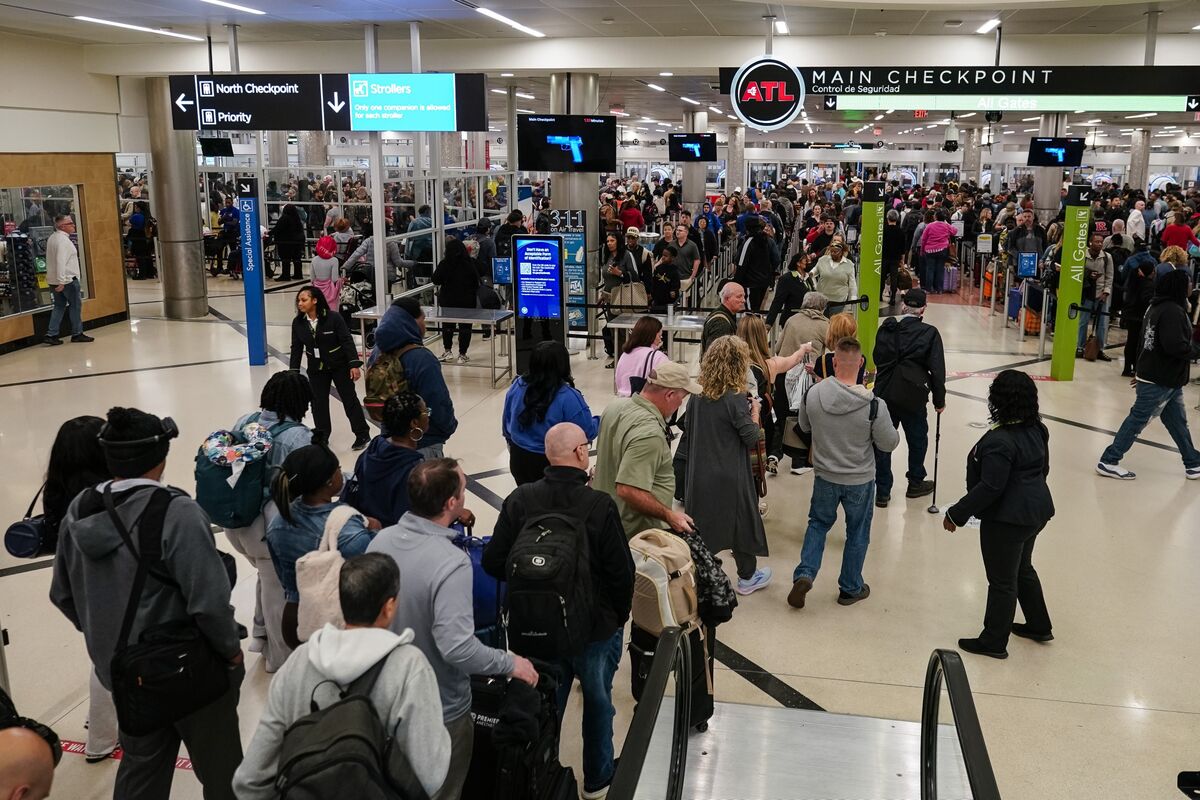
ICE will deploy agents to assist TSA during the Department of Homeland Security shutdown but only for "non-significant" tasks (e.g., guarding exits; they will not operate X-ray screening), according to border czar Tom Homan. This is a limited operational stopgap aimed at easing airport queueing with minimal implications for travel capacity or public markets.
Operationally, this is a localized staffing patch that reduces visible disruption risk but creates marginal operational friction at peak hubs. Even modest non-specialist redeployments that add 1–3 minutes to per-passenger throughput can cascade into increased taxi/turn times and gate congestion, effectively raising short‑term CASM for carriers concentrated at affected airports. The economic hit is likely uneven: network carriers with tight banked schedules and high connection rates suffer disproportionally versus point‑to‑point operators.
Second‑order beneficiaries are firms positioned to capture incremental federal spending and outsourcing: airport security integrators, TSA contractors, and companies selling screening tech and labor services. If the funding gap persists >2–6 weeks, expect overtime billings, emergency contracts, and accelerated procurement cycles — a discrete revenue and backlog catalyst for mid‑cap government contractors even if the headline political story fades. Conversely, airport concession revenues and schedule reliability metrics are the weak links; prolonged passenger friction depresses spend per pax and yields negative earnings surprises for mall-like airport operators.
Catalysts to watch are binary and short-dated: (1) funding resolution (days–weeks) that removes the staffing overhang; (2) union/agency escalation or litigation (weeks–months) that could widen scope of redeployments or force formal changes to duties; (3) procurement fast‑tracks for screening tech (1–3 quarters) if agencies decide to reduce human dependency. Tail risk: a protracted DHS impasse or reciprocal restrictions could push material demand elasticity in near‑term air travel or trigger policy shifts toward privatized screening over 12–24 months.
AI-powered research, real-time alerts, and portfolio analytics for institutional investors.
Request DemoOverall Sentiment
neutral
Sentiment Score
0.00
