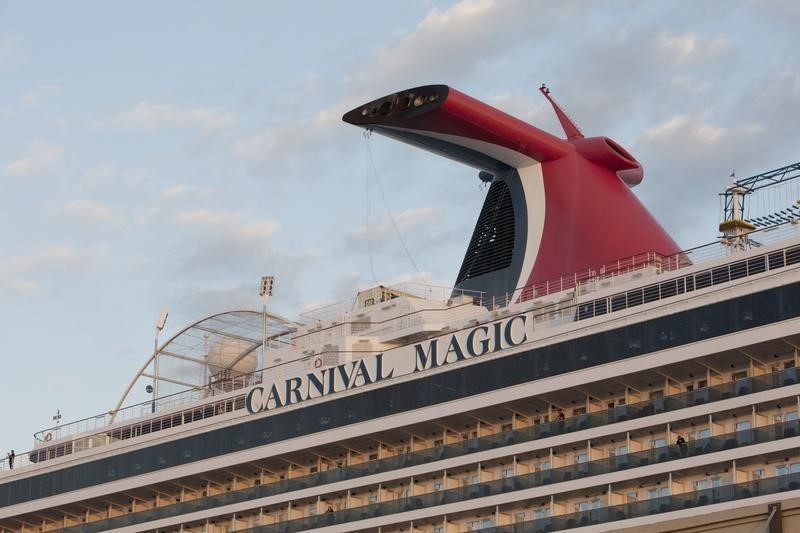
Carnival beat Q1 estimates with adjusted EPS $0.20 vs $0.18 and record revenue $6.2B (consensus $6.13B), delivering $275M adjusted net income despite a ~$54M adverse fuel/currency hit. Management raised full-year operational outlook by nearly $150M in adjusted net income but warned that recent fuel volatility tied to the Middle East conflict represents an adverse swing exceeding $500M; FY2026 adjusted EPS is ~ $2.21 and adjusted net income ~ $3.07B, with Q2 EPS ~ $0.34 and net yields +~2% CC. The company set long-term PROPEL targets through 2029 and authorized a $2.5B buyback effective after expected shareholder meetings on April 17, 2026; bookings are up double-digits with ~85% of 2026 booked and Q1 customer deposits near $8B (+~10% YoY).
Management’s decision to peg near-term fuel assumptions to recently purchased prices implies materially reduced forward-hedge coverage and leaves earnings exposed to short, sharp oil moves; for a capital-intensive, high fixed-cost operator that exposure translates into operating leverage that materializes within a single quarter if Brent gaps higher. The practical consequence: earnings volatility will correlate more tightly with weekly Brent prints and bunker differentials versus prior years, increasing the value of short-dated oil optionality for both the company and its counterparties.
Customer prepayment float and an ability to accelerate share repurchases (subject to governance) create a liquidity buffer that compresses downside for equity holders relative to peers lacking similar advance funding — but that same float also raises the opportunity cost of demand destruction if consumers reprice travel versus discretionary alternatives. FX swings amplify this dynamic because fuel and many port/service contracts are dollar-linked while revenue is increasingly international; a stronger dollar worsens unit economics in local-currency markets even if headline yields hold.
Competitively, carriers with deeper short-term fuel hedges or younger, more fuel-efficient fleets gain pricing optionality and can use promotional pricing to pressure peers; meanwhile fuel suppliers, bunker traders and bank hedging desks are short-tail beneficiaries of volatility. Key catalysts to watch: short-term oil shocks from geopolitics, the next booking cadence into peak summer travel, and governance dates that unlock capital-return optionality — any of which can rapidly re-rate relative multiples across the sector.
AI-powered research, real-time alerts, and portfolio analytics for institutional investors.
Request DemoOverall Sentiment
mildly positive
Sentiment Score
0.25
Ticker Sentiment
