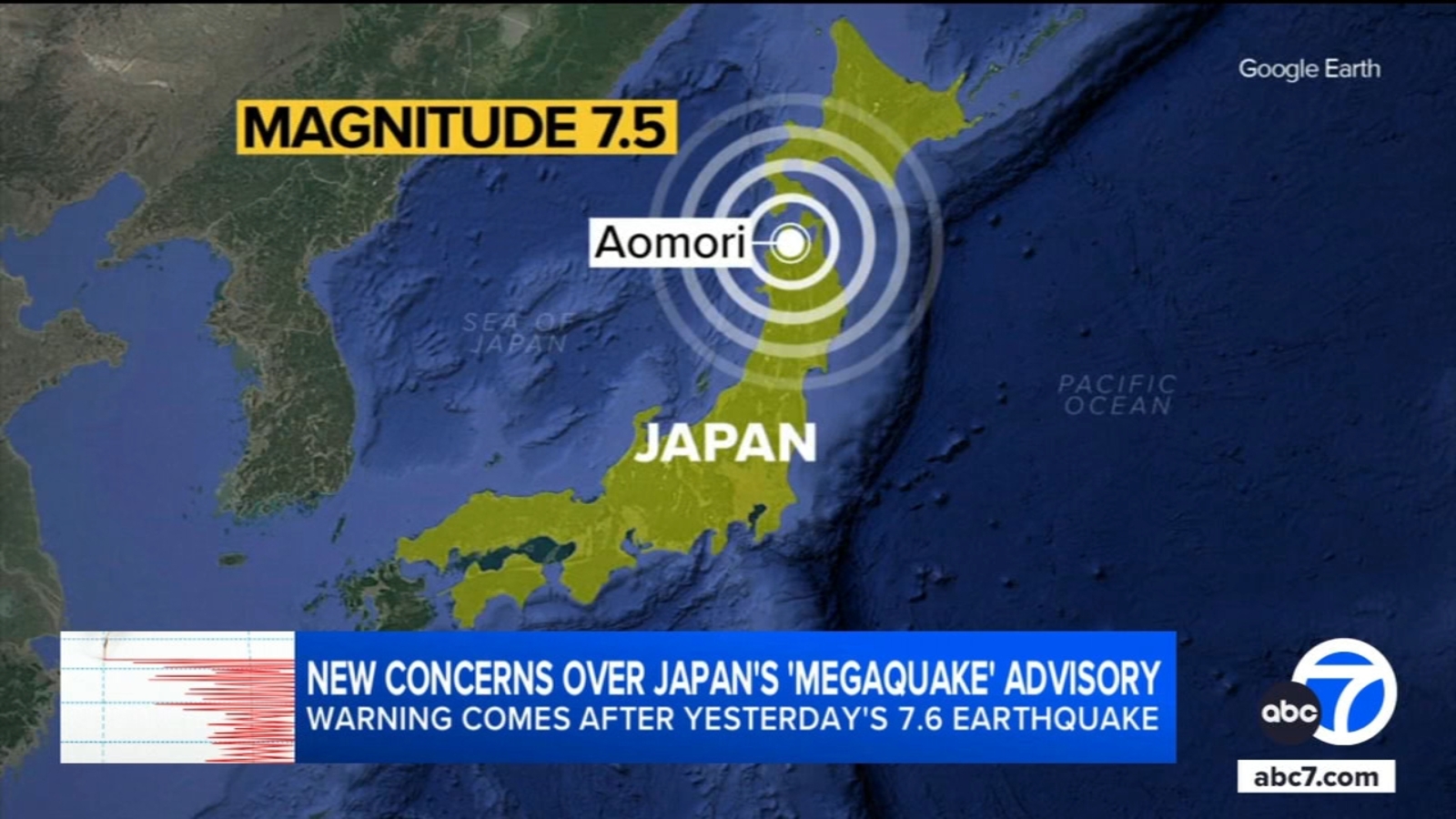
Japan issued a megaquake advisory after a magnitude‑7.5 tremor off Aomori that caused modest immediate damage and 34 mostly mild injuries, but prompted the Japan Meteorological Agency to warn of an increased short‑term chance of a larger, magnitude‑8+ event (officially put at roughly 1%). The advisory spans 182 municipalities from Hokkaido to Chiba and evokes the 2011 M9.0 disaster—the government’s scenario for a Hokkaido‑Sanriku megaquake projects up to a 30‑meter tsunami, as many as 199,000 fatalities and up to ¥31 trillion (~$198bn) in economic losses, with even larger modeled impacts for a Nankai Trough event—so officials are urging immediate preparedness (emergency bags, evacuation plans, securing furniture). The move is intended to spur readiness and avoid the confusion and market‑disrupting panic buying and business shutdowns that followed last year’s ambiguously worded advisory.
A magnitude 7.5 earthquake struck off Aomori with modest immediate damage—34 mostly mild injuries and some road and building damage—prompting the Japan Meteorological Agency to issue a megaquake advisory covering 182 municipalities from Hokkaido to Chiba. Officials characterized the advisory as not a prediction and put the probability of a magnitude 8+ event at about 1%, while warning of an increased short-term risk within the next week and urging readiness (emergency bags, evacuation plans, securing furniture).
The advisory is anchored in historical precedent: the 2011 M9.0 quake followed a M7.3 foreshock two days earlier, and government modeling projects a Hokkaido–Sanriku megaquake could generate up to a 30‑meter tsunami, as many as 199,000 fatalities and up to ¥31 trillion (~$198bn) in economic losses; a Nankai Trough scenario carries even larger modeled losses (up to ¥200 trillion / $1.28tn). Seismologist Dr. Lucy Jones noted foreshock sequences can produce low‑probability but high‑consequence larger quakes, so the advisory aims to reduce loss of life rather than predict timing.
Market and operational implications are primarily downside tail‑risk and short‑term behavioral disruption: last year’s ambiguous advisory led to panic buying, event cancellations and business closures, and authorities now emphasize targeted preparedness. The combination of modest current damage but elevated modeled catastrophic exposure implies potential volatility for insurers, coastal real estate, utilities and tourism/recreation businesses serving the affected municipalities until seismic risk clarity returns.
AI-powered research, real-time alerts, and portfolio analytics for institutional investors.
Request DemoOverall Sentiment
moderately negative
Sentiment Score
-0.40
