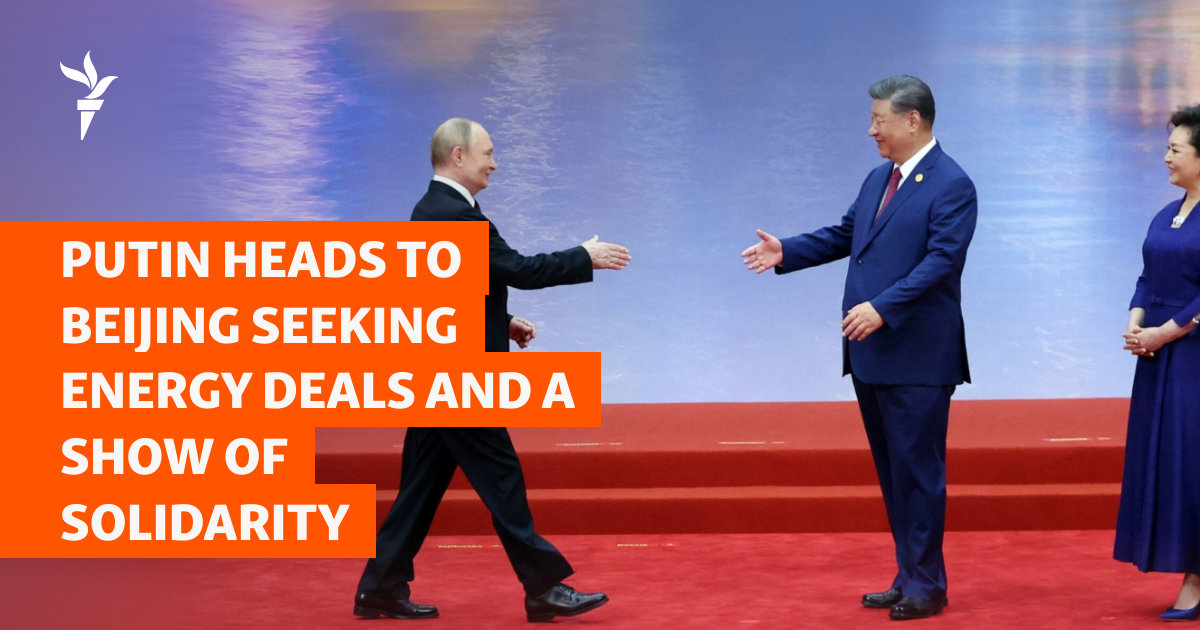
Putin’s two-day Beijing visit comes as the wars in Iran and Ukraine are reshaping global energy flows, with the Strait of Hormuz closure disrupting about one-fifth of global oil supplies. China has bought more than $367 billion of Russian fossil fuels since the war in Iran began, and energy security, including the proposed Power of Siberia-2 pipeline, is a central topic. The article signals continued geopolitical alignment between Russia and China, with potential implications for oil, LNG, and pipeline flows, but no near-term deal breakthrough is evident.
The immediate market read-through is not “more Russia-China trade,” but a further hardening of the marginal barrel pricing mechanism. If Beijing continues to absorb discounted Russian crude and incremental LNG while Hormuz risk keeps alternative supply chains impaired, the biggest winner is not Russian upstream equity—it's the coastal, non-sanctioned Asian storage/logistics complex and refiners with flexible feedstock books that can arbitrage dislocations. The second-order loser is any producer whose sales depend on prompt cargo re-routing, because sanctions friction and shipping insurance costs create a wider basis between headline Brent and netback realizations.
The more interesting medium-term effect is on capital allocation in Chinese energy security. A true acceleration of overland gas buildout would be negative for LNG import growth expectations over a 2-5 year horizon, but the article implies that pipeline relief is too slow to solve a near-term supply shock. That supports a “bridge fuel” regime: higher spot LNG, elevated FSRU utilization, and stronger utilization for non-Russian pipeline interconnectors in Central Asia. It also pressures European gas sentiment indirectly, because any sustained rerouting of seaborne molecules to Asia tightens the Atlantic Basin balance even if European demand is unchanged.
Geopolitically, the key risk is not a bilateral Russia-China breakthrough; it’s a de-escalation in the Middle East that removes the urgency premium before Moscow can monetize it. That creates a fade-the-spike setup in energy if headlines cool over the next 2-6 weeks, especially since pipeline projects are years away and politically negotiable pricing has a history of stalling. Conversely, if the conflict persists, the market may underestimate how quickly China can increase procurement from non-Russian alternatives, limiting the duration of the rally in Russian export leverage.
The contrarian point: consensus may be overestimating Russia’s pricing power and underestimating China’s buyer leverage. Beijing can use this moment to extract deeper discounts, longer tenors, and infrastructure concessions without committing to near-term volume growth. So the trade is less about chasing Russian commodity exposure and more about positioning for volatility compression in refined products and gas once the supply shock is partially rerouted.
AI-powered research, real-time alerts, and portfolio analytics for institutional investors.
Request DemoOverall Sentiment
mildly negative
Sentiment Score
-0.15
