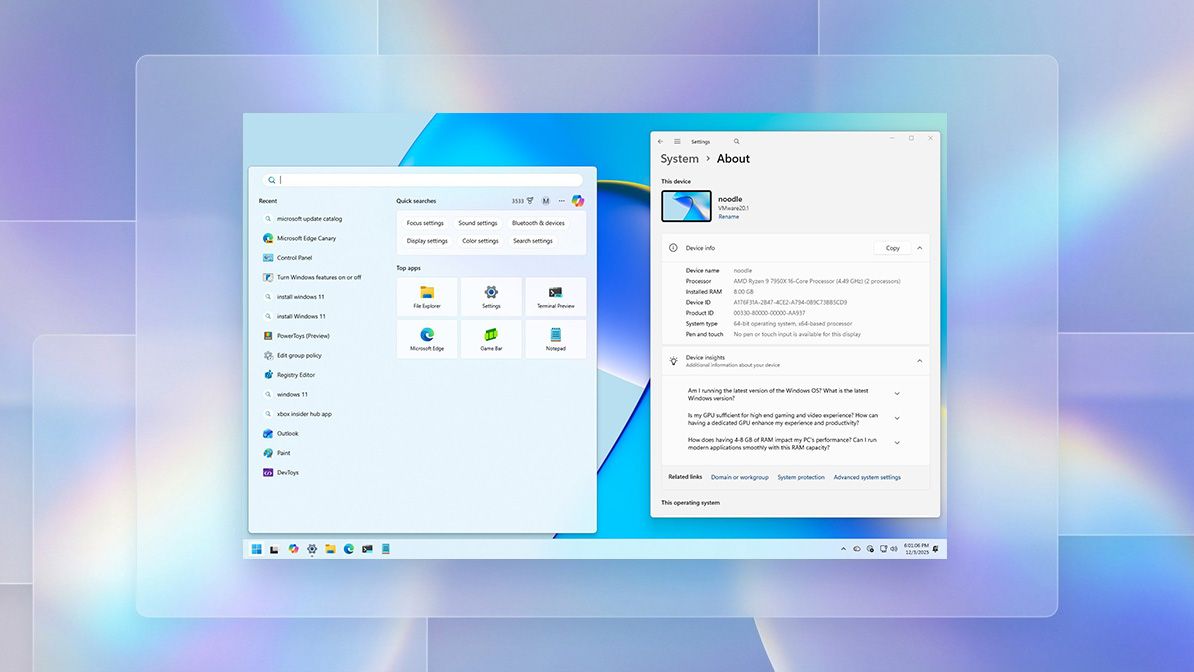
Microsoft will begin rolling out its December 2025 Windows 11 cumulative update (Stable Channel, 24H2/25H2) with UI refinements (Start menu/Windows Search alignment, File Explorer dark-mode fixes), Settings redesigns (Device info card, Mobile Devices integration, About page), virtualization management via a new Virtual Workspaces page, Widgets redesign, haptics for pens and expanded Xbox Full Screen Experience for handhelds. Several AI features (Windows Recall, Click to Do, Windows Studio Effects for secondary cameras) are gated to Copilot+ PCs with NPUs capable of 40+ TOPS and require BitLocker/Windows Hello, a constraint that could modestly influence demand for qualifying devices and partner silicon. Immediate market impact is limited, though the hardware and gaming feature expansions could provide incremental tailwinds for OEMs and silicon vendors over time while the update’s lingering UI bugs and staged rollout temper near-term effects.
Market Structure: Microsoft (MSFT) gains modest incremental monetization leverage from Copilot+ tie‑ins and UI improvements — expect revenue mix lift from device OEM promotions and UX stickiness rather than immediate GAAP revenue jumps; estimate addressable Copilot+ PC attach rate of 5–10% of Windows installs in 12 months if OEMs push NPU hardware, supporting 1–3% EPS upside for MSFT over 4 quarters. AMD and INTC are direct hardware winners if demand for 40+ TOPS NPUs grows; AMD is better positioned for mobile/desktop APUs while INTC faces execution risk. CSCO sees neutral-to-small upside from security/networking demand (BitLocker/enterprise management).
Risk Assessment: Key tail risks are regulatory/privacy actions (EU/US investigations into on‑device AI and data flows) and supply constraints for NPU silicon creating >10% price swings in vendor stocks; buggy rollouts (white flashes, broken UX) could delay enterprise adoption by 6–12 months. Immediate (days) impact should be muted; short term (weeks–months) depends on holiday PC cycle and OEM promotions; long term (quarters) depends on recurring Copilot subscriptions and hardware attach. Hidden dependencies: OEM incentives, BitLocker/Windows Hello opt‑in rates, and third‑party driver stability.
Trade Implications: Tactical portfolio: establish a 2–3% long in MSFT (buy 3–6‑month slightly OTM calls as asymmetric kicker) and 1–2% long in AMD via call spreads to express NPU demand; consider a relative value pair long AMD / short INTC (equal notional) sized 1% each to exploit Intel execution risk. Use a conservative hedge: buy 2–3% portfolio protection (put spread on Nasdaq/XLK) if regulatory headlines escalate; time entries within 2–6 weeks around OEM holiday promotions and exit or reassess into March 2026 results.
Contrarian Angles: Consensus minimizes recurring software monetization from Copilot UI hooks — if MSFT converts 10–15% of active Windows users to paid Copilot features within 2 years, valuation upside is underappreciated (target +5–8% fair value). Conversely, hardware upgrades required for full AI features may be overestimated by markets; if NPU adoption stalls, AMD/INTC upside will underperform expectations. Historical parallel: Windows feature cycles typically lead to deferred, modest OEM revenue gains; monitor OEM bundling terms and Copilot subscription ARPU over next 2 quarters as decisive signals.
AI-powered research, real-time alerts, and portfolio analytics for institutional investors.
Request DemoOverall Sentiment
neutral
Sentiment Score
0.00
Ticker Sentiment
