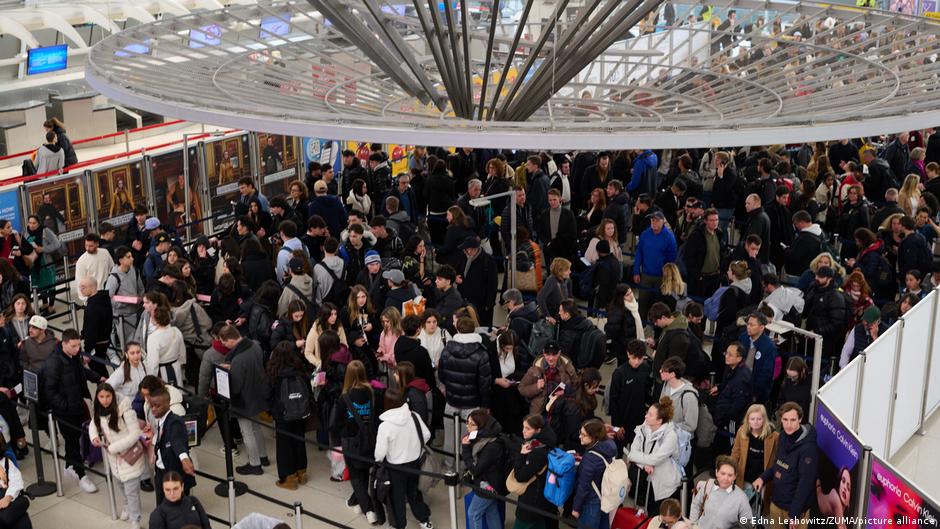
Nearly 500 TSA officers have quit and roughly 50,000 TSA officers have been working without pay since mid-February due to a partial DHS funding shutdown, causing hours-long lines at airport security amid ~5% higher travel volume year-over-year. The White House is considering emergency funding to pay TSA while ICE agents — backed by prior appropriations that included about $75 billion for ICE operations — are being deployed to assist with ID checks, access control and crowd management despite lacking TSA training. Democrats demand ICE reform and guardrails to restore DHS funding, while Republicans propose funding most of DHS but excluding ICE enforcement. Operational disruption raises short-term downside risk to airlines, airports and travel-related services through degraded customer experience and potential closures at smaller airports.
A transient staffing shortfall at airport security creates outsized network economics: small percentage drops in throughput amplify delay minutes nonlinearly across hub-and-spoke schedules, raising per-ASM costs and increasing irregular operations (crew re‑reads, hoteling, swap costs). Quantitatively, a sustained 5–10% throughput reduction during a peak week can erode airline EBITDA by mid-single-digit percent for that quarter through lost pax, higher re‑accommodation costs and lower ancillary conversion.
Second-order winners are companies that supply security hardware, software and outsourced screening capacity — budget re-prioritizations and political pressure make accelerated procurement (body cams, screening upgrades, ID-verification systems) a multi-quarter story. Losers extend beyond carriers: municipal airport finances (smaller airports with thin passenger revenue) face meaningful cashflow stress that can force service cuts or accelerated privatization of ground services, benefiting private contractors but depressing municipal muni bonds in the near term.
Timing and catalysts are concentrated: operational pain is immediate (days–weeks) and will pressure headlines during peak travel windows; policy resolution is a medium-term (1–8 week) event driven by legislative bargaining or executive funding workarounds. Tail risk — a security incident or multi-week labor exodus — would convert a regional disruption into a durable demand shock for travel and trigger insurance/litigation flows lasting quarters.
From a positioning perspective, prefer short-duration defensive shorts on travel exposure into the next 4–8 weeks while adding asymmetric, longer-duration longs to capture reallocation of DHS budgets toward tech and private providers over 6–12 months. Hedging event risk with tight-defined option structures reduces gamma bleed if the political outcome prints sooner than expected.
AI-powered research, real-time alerts, and portfolio analytics for institutional investors.
Request DemoOverall Sentiment
strongly negative
Sentiment Score
-0.60
