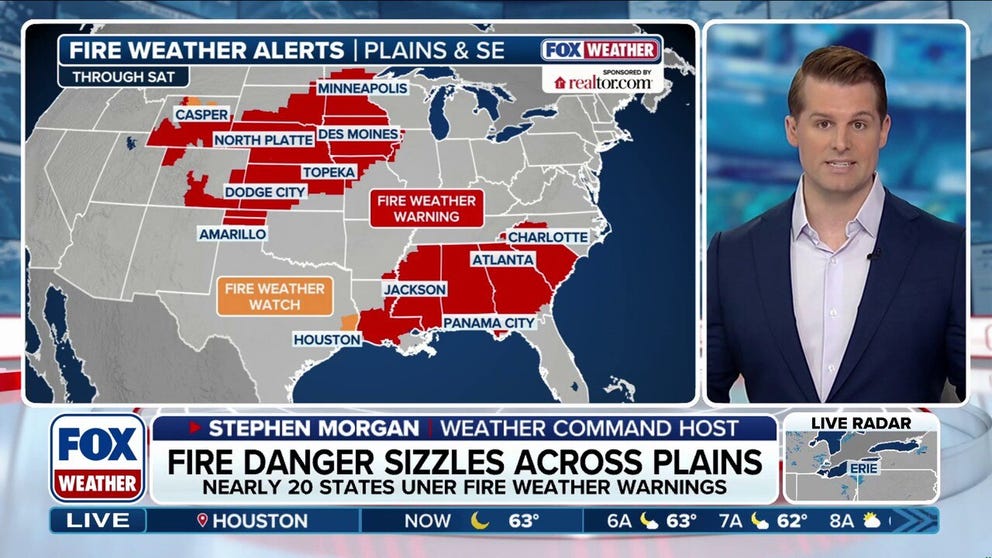
Nearly 50 million people across 18 states are under Fire Weather Warnings as a cold, dry Arctic air mass drops temperatures by 20-30°F in parts of the Southeast and 10-20°F across the Deep South, with humidity falling into the teens in many areas. Sustained winds of 10-30 mph (gusts up to ~45 mph) from a tightening pressure gradient are creating low-humidity, high-wind conditions that greatly increase rapid wildfire spread risk; warnings span western North Carolina through Louisiana (including parts of the Florida panhandle), a Fire Weather Watch in east Texas, and across the Plains from Minnesota down to northern Texas (west to Wyoming and some Illinois counties). The event elevates short-term risk to regional utilities, energy demand/operations, transportation and insurance exposure (note the Morrill Fire burned >640,000 acres and is now contained); relief is expected east of the Mississippi by Sunday while Plains danger may linger.
This weather swing acts less like an isolated meteorological event and more like an accelerant for already-pressured risk pools and grid investment plans. In the near-term (days–weeks) the primary channel is claims and operational disruption: ignition events increase expected loss frequency and create short-lived demand shocks for resilience hardware (backup generators, portable transformers) and labor for mitigation and line repairs. Over months the more consequential second-order effects appear in pricing — insurers and reinsurers will re-run catastrophe models, which should translate into firmer renewal pricing, wider retrocession spreads, and faster reallocation of capital away from high-frequency wildfire footprints.
For energy markets the net is nuanced: reduced solar output from smoke and damaged distribution lines raises marginal fuel demand for dispatchable generation, but stronger winds lift wind generation and can reduce load via cooling relief in some regions. That dynamic creates localized price dispersion rather than a national move — useful for regional power and fuel basis trades. For utilities and T&D equipment suppliers, repeated wildfire seasons shorten replacement cycles and push accelerated undergrounding and vegetation management capex, converting a margin-reducing O&M shock today into a multiyear capex growth opportunity for select vendors.
The policy and capital side matter: states and municipalities respond post-event with stricter permitting and higher liability standards for utilities, which increases allowed-rate pressure but also mandates remediation spending that utilities will seek to recover through tariffs. Reinsurance and catastrophe bond markets are the clearest barometer to watch — widening spreads and reduced capacity are likely within 1–2 renewal windows if losses cluster, creating an attractive entry for well-capitalized reinsurers and investors able to stomach near-term loss volatility. Key catalysts to monitor are loss reporting cadence in the first 30 days, reinsurance renewals in the coming quarters, and regional power dispatch/solar insolation anomalies over the next 2–6 weeks.
AI-powered research, real-time alerts, and portfolio analytics for institutional investors.
Request DemoOverall Sentiment
mildly negative
Sentiment Score
-0.25
