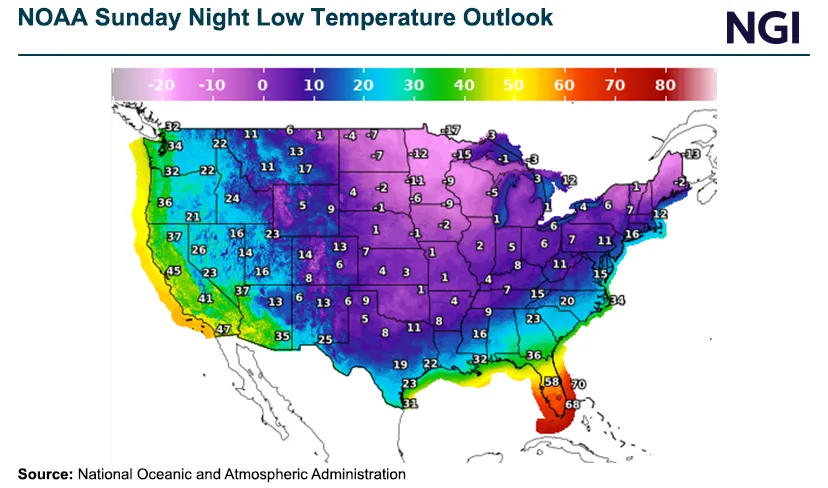
A severe cold snap across the United States is forecast to cause more than 70 Bcf of freeze-offs, constraining natural gas production, disrupting pipeline flows and hampering operations at power plants and LNG export terminals. The disruption threatens near-term reductions in LNG exports and tighter domestic gas supply, creating upside risk to U.S. natural gas and power prices as pipelines and operators prepare for low-temperature impacts.
Market structure: A 70+ Bcf freeze-off is material — roughly equivalent to a multi-day U.S. production loss — which will sharply tighten front-month Henry Hub and domestic basis differentials. Short-duration winners: withheld-supply storage holders, coal producers pushing into power dispatch, and LNG buyers in Asia (if U.S. exports pause) who can arbitrage cargoes; losers: gas-weighted E&Ps in affected basins, gas-fired generators, and operators of coastal LNG trains facing force majeure, compressing near-term cash flows and raising volatility.
Risk assessment: Immediate (days) risk is production curtailment and pipeline flow reversals; short-term (weeks) risk is sustained price spikes and power outages; long-term (quarters) risk is accelerated capex for winterization and regulatory scrutiny. Tail risks include prolonged outages causing force majeure at multiple LNG trains (months), cascading counterparty margin calls, or regulatory price interventions; key hidden dependency is basis — Haynesville/Haynesville-connected producers can pick up share if Appalachia freezes.
Trade implications: Favor directional short-dated natural gas call spreads and volatility buys rather than single-stock punts. Relative-value: long U.S. thermal coal (BTU) vs short gas-fired generators (NEE) if HH crosses +20% vs 30‑day average; consider short-term put protection on LNG exporters (LNG). Timing: enter within 48–72 hours while cold is peaking; unwind as NOAA 7–14 day shows >60% warming probability or EIA weekly draw normalizes.
Contrarian angles: Consensus assumes uniform production collapse; it understates regional resilience (e.g., Haynesville, Rockies) and logistical re-routing that can blunt price moves after ~2–4 weeks. Historical analogs (Feb 2021, Dec 2022) show violent spikes then reversion — implying option premia may be overpriced for multi-month exposure and a mean-reversion hedge/short-vol stance can be profitable if warming signals arrive.
AI-powered research, real-time alerts, and portfolio analytics for institutional investors.
Request DemoOverall Sentiment
moderately negative
Sentiment Score
-0.45
