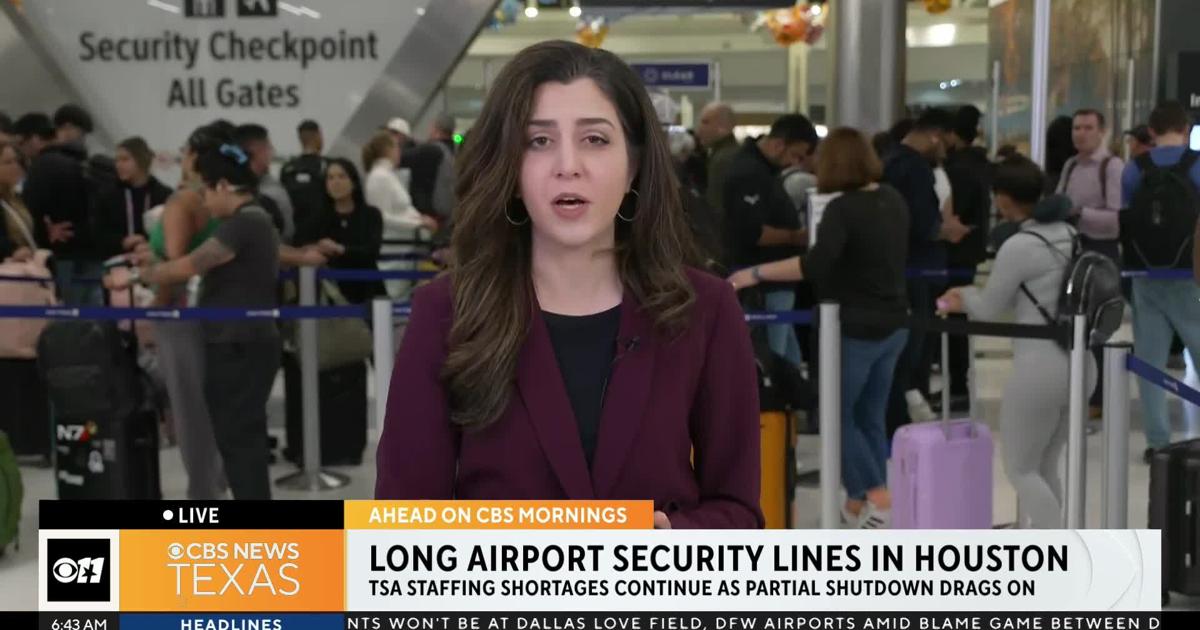
Partial federal shutdown (began Feb. 14) has left TSA officers in North Texas working without regular pay for over a month (one officer reported last full paycheck >1 month ago; one week paid five weeks ago), creating staffing shortages that could force multiple security checkpoint closures and significant traveler delays. Union is coordinating delivery of two truckloads of food to support employees; lawmakers are reportedly nearing a deal but any agreement may be too late to prevent another missed paycheck this weekend.
A short-lived payroll disruption for frontline airport screening has outsized operational leverage: small staffing shortfalls (5–15%) can translate into throughput losses of 10–30% during peak windows because screening is a serial bottleneck with limited slack. That nonlinearity amplifies airline schedule fragility — missed early flights cascade across the day, forcing rebooks, crew deadheads, and incremental overnight costs that flow straight to margins.
Second-order winners and losers are not limited to carriers: regional airports and smaller carriers that cannot flex resources will see the largest revenue and cost shocks, while renters, car-rental and ground-transport providers could capture displaced travel demand in the near-term. Vendors who can be rapidly deployed (outsourced screening, mobile imaging, contactless biometrics) stand to win if procurement accelerates; conversely, concessionaires and parking revenue tied to on-time passengers are first-order losers.
Catalysts and timeframes are short: a funding resolution within days largely negates multi-week structural impact, while a protracted gap (weeks–months) forces operational reconfiguration — surge hiring, contracting, or automation investments — that permanently raises airport operating costs. Tail risks include simultaneous hub bottlenecks during holiday/peak travel windows and political brinkmanship that pushes payroll disruptions beyond a payroll cycle, at which point behavior (resignations, mode-shift to car/rail) becomes sticky.
Market reaction should be treated as a short-duration event trade: price dislocations will compress quickly upon funding clarity, so options/short-dated structures are the efficient instruments. Watch implied volatility in travel/airport names; elevated vols mean you can sell premium against directional views while keeping defined risk profiles.
AI-powered research, real-time alerts, and portfolio analytics for institutional investors.
Request DemoOverall Sentiment
moderately negative
Sentiment Score
-0.45
