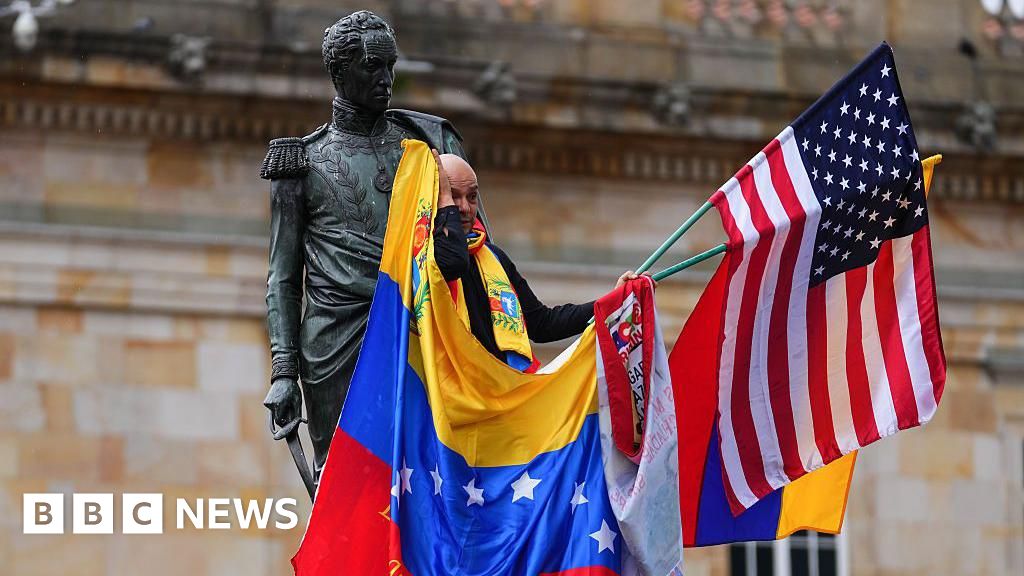
U.S. forces captured Venezuelan President Nicolás Maduro and began extraditing him to New York to face drug-trafficking and weapons charges, while the U.S. signalled it will manage Venezuela until a replacement is established and may control the country's oil reserves. Street reactions in Venezuela are mixed—celebration among opponents and protests by government loyalists—raising near-term political risk and uncertainty about control of oil production and governance. The move creates a material geopolitical shock with potential volatility for Venezuelan assets and energy markets, though immediate market impact will depend on how control of oil output and domestic security are resolved.
Market structure: A U.S.-led removal of Maduro creates a binary shock—near-term winners are oil trading houses, U.S. majors (XOM, CVX) and oilfield service firms (SLB) that could be first bidders for reopened assets, while losers include PDVSA/sovereign bondholders, Russian/Chinese contractors and regional banks with Venezuela FX exposure. Pricing power will shift toward capital-rich Western firms for reconstruction, but operational constraints (dilapidated fields) mean meaningful incremental supply likely takes 12–36 months and requires $10–30bn+ of capex.
Risk assessment: Tail risks include large-scale insurgency, sabotage of export infrastructure, or legal/asset-claim battles that could keep oil offline or reintroduce sanctions—low probability but high impact (oil spikes >20%). Immediate horizon (days–weeks) implies elevated volatility and supply-disruption premium; short-term (weeks–months) sees political jockeying and militia actions; long-term (1–3 years) depends on investment, legal settlements and OPEC responses. Hidden dependencies: army loyalty, condition of heavy-crude upgrading capacity, and Chinese/Russian strategic responses.
Trade implications: Tactical plays favor buying oil volatility (capturing a potential short-term spike) while selectively accumulating majors and services on 12–36 month thesis of asset access. Hedge tail political exposure with Venezuela sovereign CDS or short PDVSA paper; use gold (GLD) as a 1–4 week volatility hedge. Avoid outright leveraged long oil beyond 4 weeks given asymmetric operational risk.
Contrarian angles: Consensus may overestimate rapid Venezuelan supply restoration—historical parallel Iraq 2003 shows oil output recovery often lags by years. The market could overprice immediate oil upside; asymmetric option structures (limited cost, open upside) outperform naked directional exposure. Also, geopolitical backlash (regional unrest or foreign intervention) could sustain risk premia, benefiting hedges and select protection sellers.
AI-powered research, real-time alerts, and portfolio analytics for institutional investors.
Request DemoOverall Sentiment
moderately negative
Sentiment Score
-0.45
