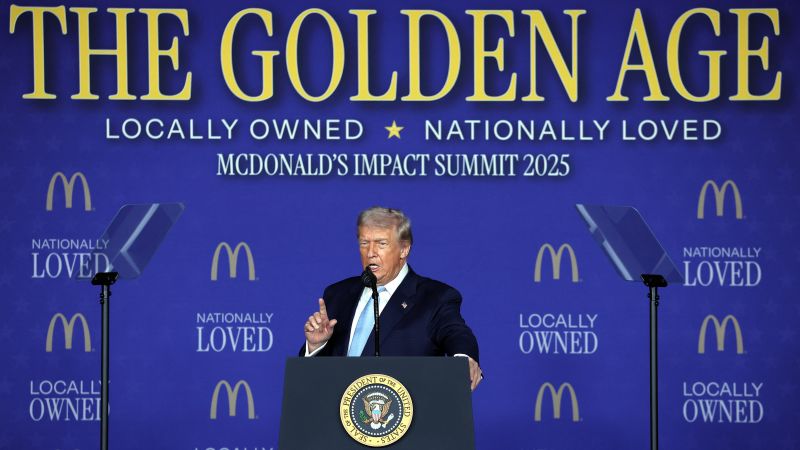
Speaking to McDonald’s franchisees, President Trump proclaimed a “golden age” with prices coming down and touted stock-market gains, but the article highlights a stark disconnect with everyday consumers who still face rising costs—headline inflation has eased to 3.0% from a 9.1% peak yet prices for food, housing and health care continue to climb. Analysts and critics point to Trump’s trade policy and tariffs as a material contributor to higher costs (the Tax Foundation estimates tariffs have acted like an average household tax of $1,200, rising to $1,600 next year), prompting piecemeal moves such as duty cuts on select foods, proposals for $2,000 tariff-revenue checks and other measures (drug-price reforms, tip-tax relief, deregulation) that may help only marginally and risk unintended inflationary effects. The resulting credibility gap between the administration’s rhetoric and lived consumer experience, underscored by polls showing broad public skepticism, raises political risk ahead of next year’s elections and suggests persistent inflation and trade friction will remain market-relevant headwinds for consumers and sectors exposed to input-cost and tariff volatility.
President Trump used a McDonald’s franchise summit to characterize the economy as a “golden age,” citing falling headline inflation and stock-market gains, while the article notes a persistent gap between that rhetoric and consumer experiences; headline inflation is down to 3.0% from a 9.1% peak, yet food, housing and health-care costs continue to rise for many households. The administration has taken targeted steps — an executive order cutting duties on beef, tomatoes, coffee and bananas and proposals such as $2,000 tariff-revenue payments and 50-year mortgages — but the piece highlights that these are marginal fixes rather than structural solutions. Independent analyses cited in the article point to tariffs as a material contributor to higher household costs, with the Tax Foundation estimating tariffs have acted like a $1,200 annual tax on the average household rising to $1,600 next year, and a CNN poll showing 61% of Americans believe Trump’s policies have worsened economic conditions. Market signals in the article show moderately negative sentiment overall (sentiment_score -0.5) but a modestly positive per-ticker view for MCD (0.3); the combination of persistent input-cost pressure, targeted tariff relief and political credibility risk implies elevated sector-specific volatility, particularly for food, housing and health-care exposed firms.
AI-powered research, real-time alerts, and portfolio analytics for institutional investors.
Request DemoOverall Sentiment
moderately negative
Sentiment Score
-0.50
Ticker Sentiment
