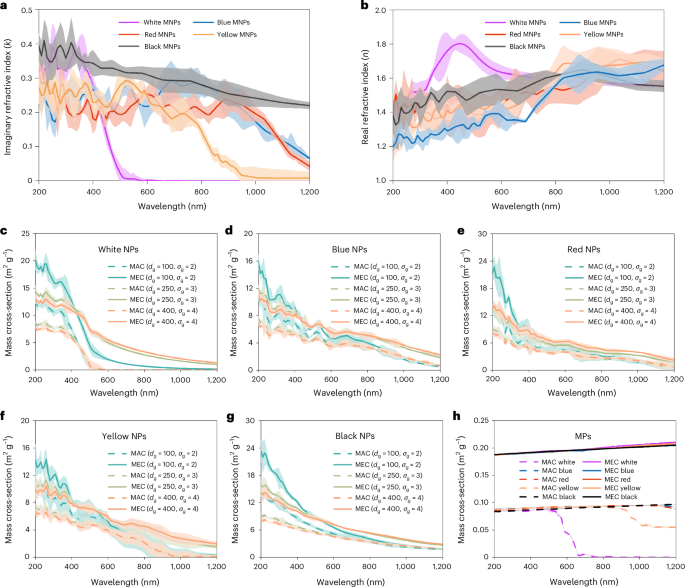
The study estimates airborne microplastics and nanoplastics generate mean direct radiative forcing of 0.039 ± 0.019 W m−2 globally, or 16.2% of black carbon’s forcing. Regional forcing peaks over the North Pacific Subtropical Gyre at about 1.34 W m−2, with colored particles absorbing 74.8 times more light than pristine plastics. The findings elevate microplastics as a previously underrecognized climate-forcing agent, but the article is scientific rather than market-specific.
This is less a tradable new climate regime than a marginal repricing of the aerosol stack: the study is effectively arguing that “plastics in air” should be modeled like a weak brown-carbon class with occasional hotspot behavior. The immediate second-order winner is not a listed plastic producer but any business exposed to airborne particle monitoring, filtration, microscopy, and environmental analytics, because the paper gives regulators a fresh forcing term to justify tighter measurement standards before they can regulate emissions. That shifts spend toward compliance, sensing, and remediation rather than upstream polymer substitution. The bigger implication is policy optionality: if atmospheric plastics become folded into climate inventories, waste-management firms, recyclers, and packaging companies face a new narrative headwind even if the forcing magnitude is modest versus core warming agents. The regional hotspot angle matters more than the global mean; a localized forcing signal creates a pathway for port authorities, shipping, coastal municipalities, and island jurisdictions to target marine-atmosphere plastic fluxes with procurement and permitting changes. In markets, that tends to show up first as small-cap ESG multiple dispersion rather than broad sector beta. The contrarian read is that the market may over-interpret a climate-science result as an investable emissions regime shift. The underlying uncertainty is still huge: source attribution, particle aging, and size distribution assumptions can move the estimate materially, and the effect is likely too diffuse to change near-term earnings for industrials or consumer plastics. The real tradeable impact is probably years out, via standards, disclosure, and litigation, not this quarter’s fundamentals.
AI-powered research, real-time alerts, and portfolio analytics for institutional investors.
Overall Sentiment
mildly positive
Sentiment Score
0.15
