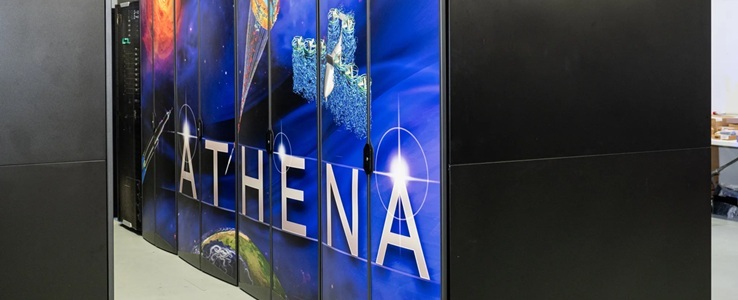
NASA has deployed Athena, a new high-end supercomputer at its Ames Research Center delivering over 20 petaflops of peak performance and replacing predecessors Aitken and Pleiades to provide greater power and efficiency. Rolled out to users in January after beta testing, Athena is available to NASA and external researchers, supports large-scale simulations and AI model development under a hybrid strategy that combines supercomputers with commercial cloud access, and is expected to reduce NASA's supercomputing utility costs.
Market structure: Athena is a demand signal for on‑prem HPC, benefiting GPU/accelerator makers (NVDA, AMD), systems/integration vendors (HPE) and semiconductor equipment suppliers (ASML, KLAC) as NASA drives multi‑year refresh cycles; defense primes (NOC, LMT, RTX) also gain via higher-fidelity mission simulations. Cloud hyperscalers (AMZN, MSFT, GOOGL) see limited offset risk because NASA adopts hybrid models; however tighter GPU supply could raise pricing power (+10–30% range in spot GPU rents) for on‑prem providers over 12–24 months.
Risk assessment: key tail risks are sudden US budget cuts or earmark reversals within 6–18 months, export‑control escalation that restricts advanced accelerators to international partners, and operational cyber/mission failures that pause procurement. Immediate market reactions (days) will be sentiment-driven; measurable procurement and earnings impact will appear in supplier order books over 3–12 months; long-term (2–5 years) risk is concentration in a few GPU vendors creating geopolitical single points of failure.
Trade implications: overweight semiconductors and datacenter infra, underweight large cloud revenue multiple names that don’t capture on‑prem upside. Tactical plays include direct equity exposure (NVDA, AMD, HPE, ASML, EQIX) and a 6‑month call‑spread on NVDA to express convexity ahead of chip cycle catalysts; set entry windows over the next 2–8 weeks and use 12‑24 month holds for equipment suppliers. Watch procurement announcements and FY2027+ budget language as primary catalysts.
Contrarian angles: the market will underprice recurring services (maintenance, software, colo) that follow a NASA supercomputer deployment — favor colocation REITs (EQIX) and niche engineering contractors rather than just chip names. Conversely, NVDA/AMD may already price this in; if NVDA fails to trade >+35% in 6–12 months, mean reversion or relative trimming is warranted. Unintended consequence: concentrated HPC capability could accelerate M&A among systems integrators and defense contractors over 12–36 months.
AI-powered research, real-time alerts, and portfolio analytics for institutional investors.
Request DemoOverall Sentiment
mildly positive
Sentiment Score
0.25
