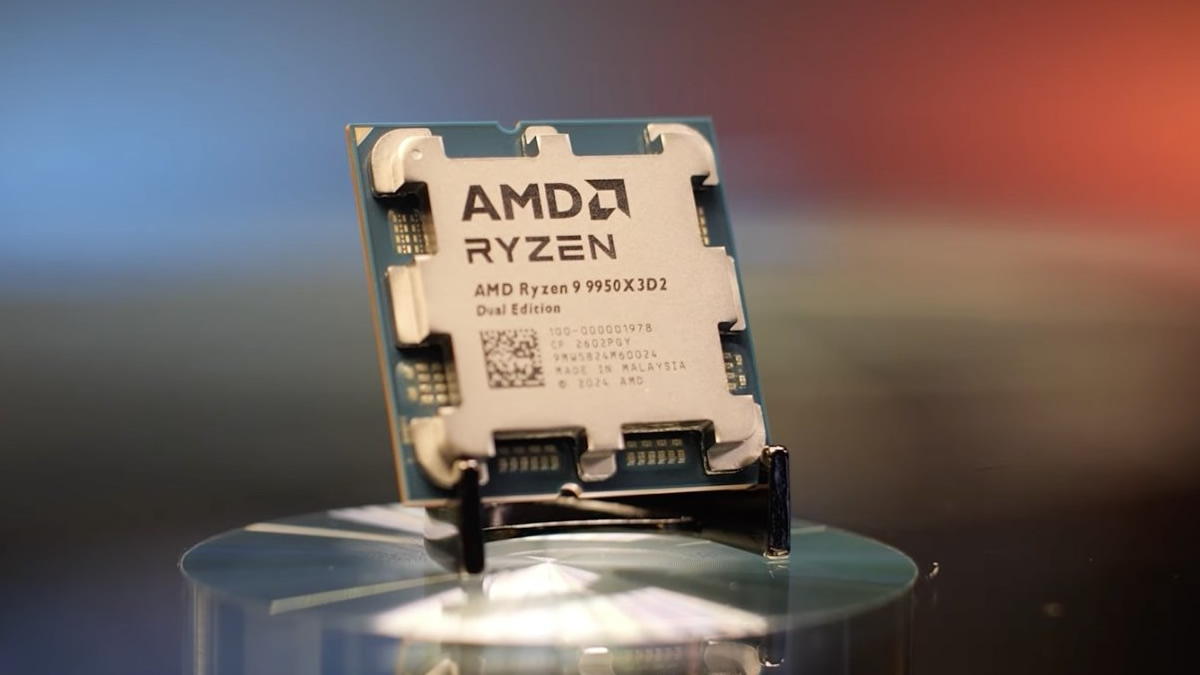
AMD announced the Ryzen 9 9950X3D2 Dual Edition CPU with 192MB total L3 3D V-Cache across dual CCDs and 16 cores, claiming 5-13% performance gains versus the 9950X3D on many complex workloads. The part is aimed at creators/developers, will be available April 22 (Q2 2026), and AMD has not disclosed MSRP; the company expects it to be priced above the current Ryzen 9 9950X3D. Monitor potential ASP and margin impacts for AMD and competitive positioning within the high-end CPU market.
This SKU is a product-design lever that shifts the buyer decision from "more cores" to "more on-die working set" for a set of professional workloads — think large code builds, interactive data-science iterations and complex video timelines. That shift is likely to compress incremental demand for ultra-high-core-count server/workstation SKUs while expanding demand at a higher ASP point in the desktop/pro segment, improving per-unit gross margin if AMD leans into premium pricing.
Upstream, the real beneficiary is advanced packaging and foundry capacity: any meaningful adoption forces additional cycles at TSMC and sustains demand for extreme-UV lithography and etch/deposition tools (ASML, LRCX/KLAC). Conversely, memory vendors selling external caches and some ECC DIMM volume could see slower growth where on-chip cache removes a purchase vector, creating a modest negative for DRAM volume growth in targeted enterprise buys.
Key near-term catalysts are independent benchmark breadth and OEM qualification cycles — if software vendors start listing this SKU as a validated configuration, OEM orderbooks will re-rate within 3–6 months. Tail risks include yield/thermal hits from denser stacking, a tepid pricing/volume mix if AMD chooses a very high ASP, or an aggressive Intel/IDM counter (3D stacking or cache-centric SKUs) within 6–12 months that narrows the window of differentiation.
AI-powered research, real-time alerts, and portfolio analytics for institutional investors.
Overall Sentiment
moderately positive
Sentiment Score
0.35
Ticker Sentiment
