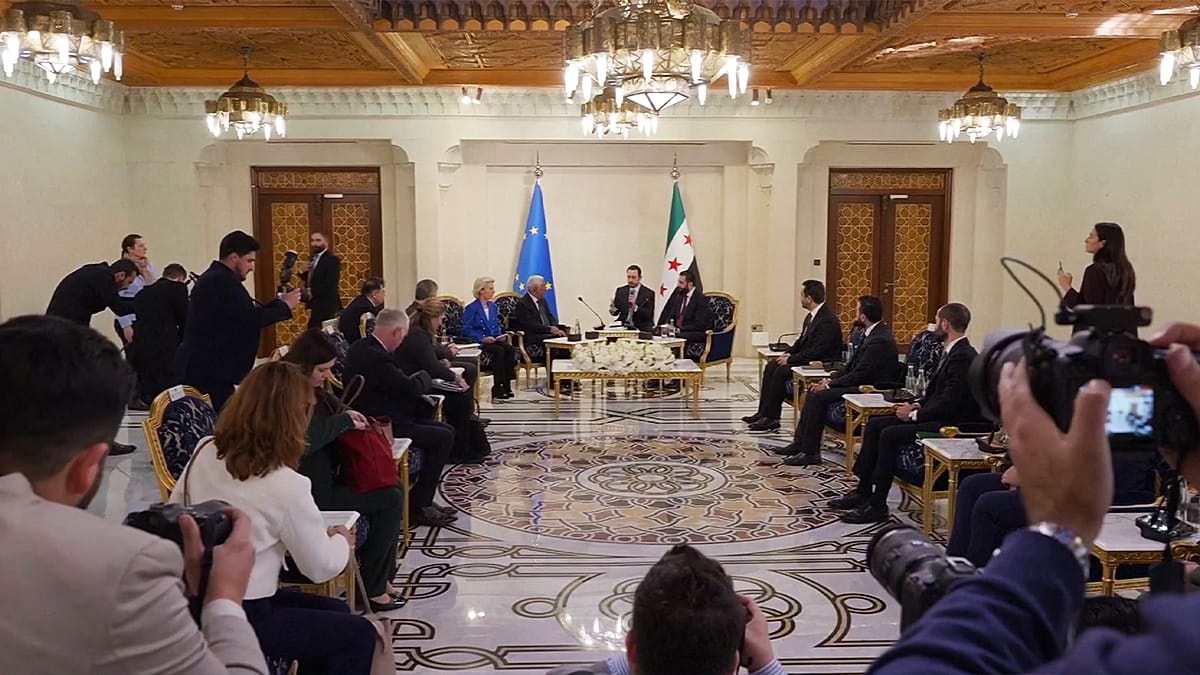
European Commission President Ursula von der Leyen visited Damascus and pledged that Europe will provide maximum support for Syria's recovery and reconstruction, coming after the EU fully lifted economic sanctions in May 2025. The EU and partners previously committed €5.8 billion at the 9th Brussels Conference, with nearly €2.5 billion earmarked for 2025–26, and discussions with interim President Ahmed al-Sharaa covered reconstruction, humanitarian aid and refugees. The visit signals a de facto reintegration of Syria into European engagement and potential reconstruction contracting opportunities, but ongoing fighting between government and Kurdish forces in Aleppo and political instability keep near-term investment and project execution risks elevated.
Market structure: EU-backed reconstruction creates clear winners — large European construction/engineering firms, oil & gas majors with Levant exposure, and bulk-material suppliers — as EU financing reduces buyer credit risk and lowers contract bid financing costs. Expect 12–36 month demand shocks for cement, steel and copper (price pressure +5–15% vs baseline) and margin tailwinds for firms able to mobilize equipment/labor quickly. Smaller local contractors, NGOs and players blocked by legacy sanctions are losers due to capital constraints and lost market share.
Risk assessment: Key tail risks are re-imposition of US/extra-EU sanctions, renewed large-scale fighting, or dominant third-party control (Russia/Iran) that sidelines Western contractors; any of these would wipe out equity gains (low-probability, high-impact). Near term (days–months) political optics drive flow; medium-term (3–12 months) ECA/guarantee rollout and tender pipelines matter; long-term (3–7 years) is the reconstruction capex cycle. Hidden dependencies: correspondent banking, ECA credit lines, and insurance/war-risk cover — absence stalls projects.
Trade implications: Tactical trade is to build small starter positions now and scale on confirmed tenders: 1–3% long allocations to VINCI (EPA: DG) and ENI (MIL: ENI) targeting 12–24 month re-rating if EU disburses >€1.5bn within 6 months; complement with 1–2% in COPX (copper miners ETF) for commodity exposure. Use 12–18 month call spreads on ENI and VINCI to cap capital; pair trade: long VINCI vs short a defense prime (e.g., RTX) to express reconstruction > new defense spend. Exit/stop: cut 50% if EU/ECA guarantees absent in 6 months or if new major sanctions occur.
Contrarian view: Markets underprice the multi-year demand for heavy materials and capital goods — consensus focuses on headline risk, not multi-year capex. Historical parallels (Balkans post-conflict reconstruction) show 3–7 year outsized returns for construction/materials; conversely reputational/ESG backlash or covert exclusion by authorities could force Western firms out, so size positions modestly and tie increases to objective contract/tender milestones.
AI-powered research, real-time alerts, and portfolio analytics for institutional investors.
Request DemoOverall Sentiment
mildly positive
Sentiment Score
0.25
