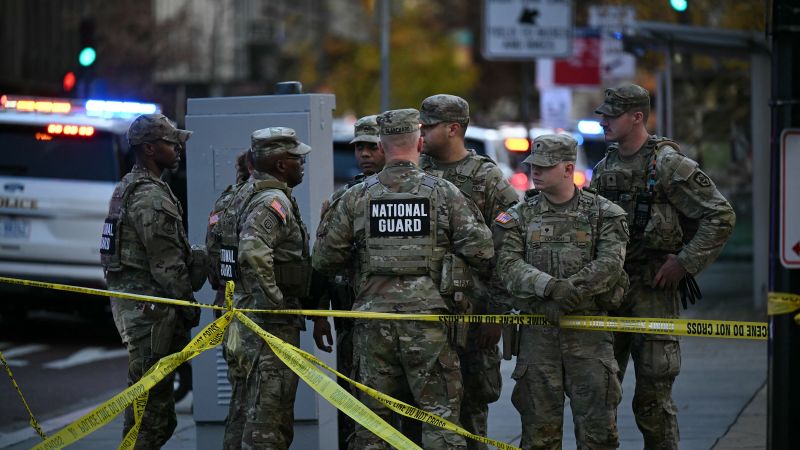
A targeted shooting in Washington, D.C., left two West Virginia National Guard reservists wounded and prompted President Trump to blame post‑withdrawal immigration vetting, naming the suspect as Rahmanullah Lakanwal, an Afghan national believed to have arrived in August 2021. The administration mobilized 500 additional Guard members and is pursuing emergency measures after a federal judge recently ruled parts of the Guard deployment unlawful, intensifying scrutiny of vetting processes, domestic troop deployments and legal challenges — developments that raise political and policy uncertainty rather than direct near‑term market shocks.
Market Structure: Near-term winners are large defense primes (RTX, LHX, NOC) and government services/intel contractors (BAH, CACI, PLTR) because political pressure increases the probability of incremental DHS/DoD spending and procurements; demand for law‑enforcement gear and surveillance tech should rise over 6–18 months, supporting pricing power on platform/software deliveries but not immediate massive revenue jumps due to long procurement lead times. Losers include hyper‑local retail/hospitality exposures in downtown DC/major cities and small-cap private security vendors that re‑rate on headline volatility and litigation risk.
Risk Assessment: Immediate (days) risk is headline‑driven risk‑off: expect a 1–3% equity pullback, T‑bond rallies (10Y down ~10–20bps) and gold +1–2% if unrest escalates. Short term (weeks–months) legal rulings and Congressional appropriations are key — appropriation is required for material budget upside (60–90 days cadence); long term (quarters) fiscal expansion could steepen yields and raise input costs for equipment manufacturers. Tail risks include domestic escalation or a court injunction reversing deployments that would remove policy tailwinds for defense names or spark broader social unrest (low prob, high impact).
Trade Implications: Tactical plays: buy 3–12 month exposure to prime defense and gov‑services while hedging headline risk; use call‑spreads to control premium. Relative value: defense primes should outperform cyclicals if political friction persists — pair long RTX vs short XLY for 1–3 months. Cross‑asset: establish short‑duration Treasury positions as a hedge for 0–6 weeks; flattening/steepening bets should wait until budget language is visible.
Contrarian Angles: Consensus likely overcounts immediate revenue upside — procurement cycles and Congress are chokepoints, so small defense names may be overbought; this creates mispricings where large primes (RTX, NOC) trade at more rational multiples while small contractors gap higher and become vulnerable to 15–30% mean reversion once headlines cool. Historical parallel: post‑terror headlines spike defense sentiment for 3–12 months but durable revenue shifts require appropriation and program awards (9–18 months). Monitor appropriations votes and court rulings as binary catalysts.
AI-powered research, real-time alerts, and portfolio analytics for institutional investors.
Request DemoOverall Sentiment
moderately negative
Sentiment Score
-0.40
