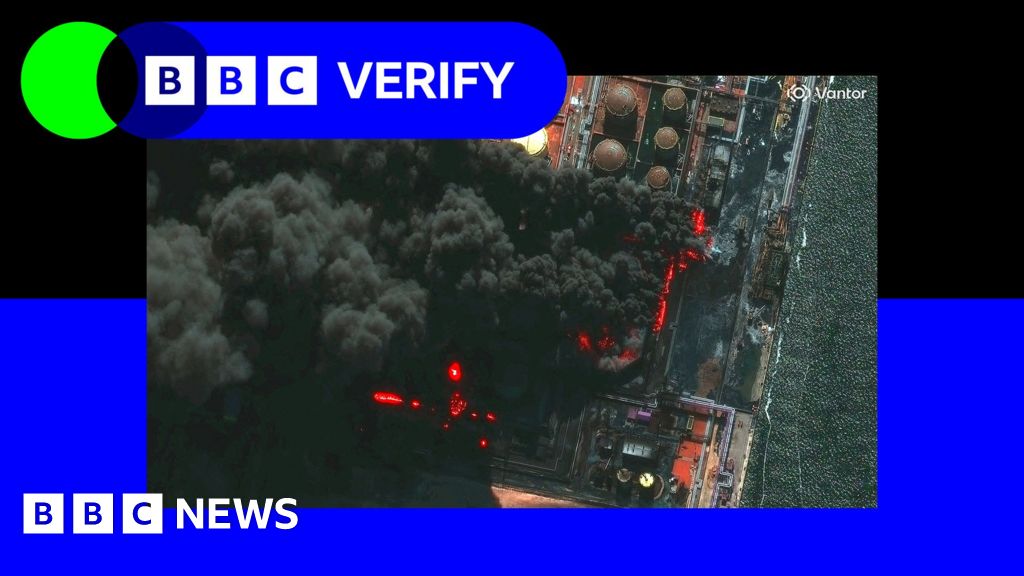
At least three Russian Baltic oil export sites (Primorsk, Ust-Luga, Kirishi) were struck between 23–28 March, with satellite analysis showing at least eight tanks damaged at Primorsk and Ust-Luga and two at Kirishi. Reuters estimates ~40% of Russia's oil export capacity was halted on 25 March; Crea notes Primorsk and Ust-Luga account for ~22% and ~20% of 2025 exports respectively, and Russia earned ~£7.1bn from oil exports in the final three weeks of March. The strikes have produced sustained fires, disrupted loading (no shiploads in the three Baltic ports on 26–27 March) and risk upward pressure on global oil prices, while allies have urged Kyiv to curb energy-sector strikes to limit global energy-market fallout.
Disruption to Russia's northwestern seaborne export nodes creates an acute, metric-ton-to-barrel shock to the tanker market: expect dirty crude tonne-mile demand to rise materially as barrels are rerouted to fewer southern terminals. Mechanically, longer voyages and transshipment raise VLCC/Suezmax/Suez-route utilization, which historically translates into 30–80% spikes in spot dayrates over a 2–8 week window, concentrating upside in owner-equity and chartering firms rather than refiners.
On oil prices, the direct supply gap is likely to be measured in the mid‑hundreds of kb/d rather than multiple mb/d, so price impact should be sharp but short-lived unless damage persists or escalates; a sustained outage of several weeks would plausibly add $5–12/bbl to Brent, while a rapid diplomatic or operational workaround could erase most of that within 4–6 weeks. Central bank and fiscal responses (SPR releases, allied diplomatic pressure on strike cadence) are credible, near-term reversal catalysts that investors should treat as high-probability tail mitigants.
Medium-to-longer term, the event accelerates two structural shifts: higher insurance and freight premia for Northern European/Arctic transits and a reallocation of capital toward resilient logistics (pipeline tie‑ins, deeper-water berths, storage hubs). Those shifts raise the marginal cost of trade and favor companies owning flexible storage and tanker capacity; they also increase capex needs for port reconstruction, prolonging any permanent dislocation to 6–18 months if repair cycles and insurance disputes become contentious.
Geopolitically, the most important non-linear risks are policy: (1) allied pressure on the strike actor to pause to stabilize global markets, and (2) retaliatory export controls or artificial supply shut‑ins by the supplier state to maintain domestic energy discipline. Both are low‑to‑medium probability but have asymmetric outcomes—rapid market calm on the former; protracted elevated energy premia on the latter—so position sizing must reflect binary outcomes over a 1–3 month horizon.
AI-powered research, real-time alerts, and portfolio analytics for institutional investors.
Request DemoOverall Sentiment
mildly negative
Sentiment Score
-0.35
