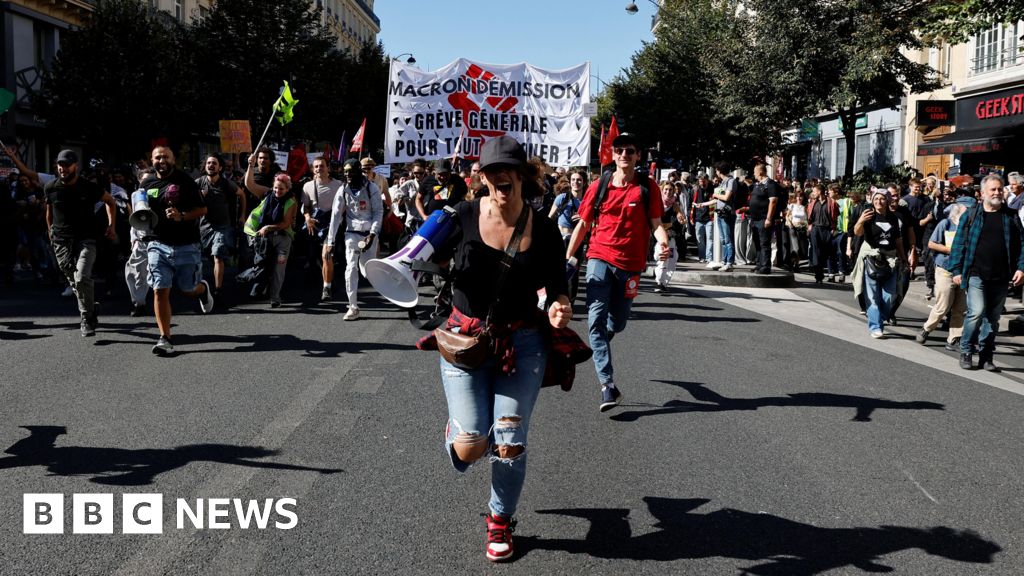
Hundreds of thousands of French workers are striking nationwide against proposed budget cuts, causing significant disruption to public services and businesses. This widespread opposition, following the recent ousting of the previous Prime Minister over his €44 billion austerity plan, underscores the severe political instability and public resistance to fiscal reforms aimed at addressing France's high public debt. The new Prime Minister, Sébastien Lecornu, faces a challenging political landscape with a hung parliament, indicating continued uncertainty regarding the government's ability to implement necessary fiscal consolidation and potentially impacting France's economic stability and bond markets.
Widespread industrial action across France, with an estimated 600,000 to 900,000 participants, signals intense public and union opposition to fiscal consolidation, creating significant headwinds for the new government. This protest, which has disrupted public transport, schools, and businesses, follows the recent ousting of a prime minister over a proposed €44 billion budget cut. The core issue is a deeply entrenched political stalemate within a hung parliament, which has already toppled two previous governments and leaves the new Prime Minister, Sébastien Lecornu, in a perilous position. While France faces spiraling public debt, equivalent to nearly €50,000 per citizen, the political appetite for austerity is non-existent, with unions demanding increased spending and higher taxes on the wealthy. This impasse between fiscal necessity and political reality elevates policy uncertainty and poses a material risk to France's economic stability and sovereign credit outlook.
AI-powered research, real-time alerts, and portfolio analytics for institutional investors.
Request DemoOverall Sentiment
strongly negative
Sentiment Score
-0.65
