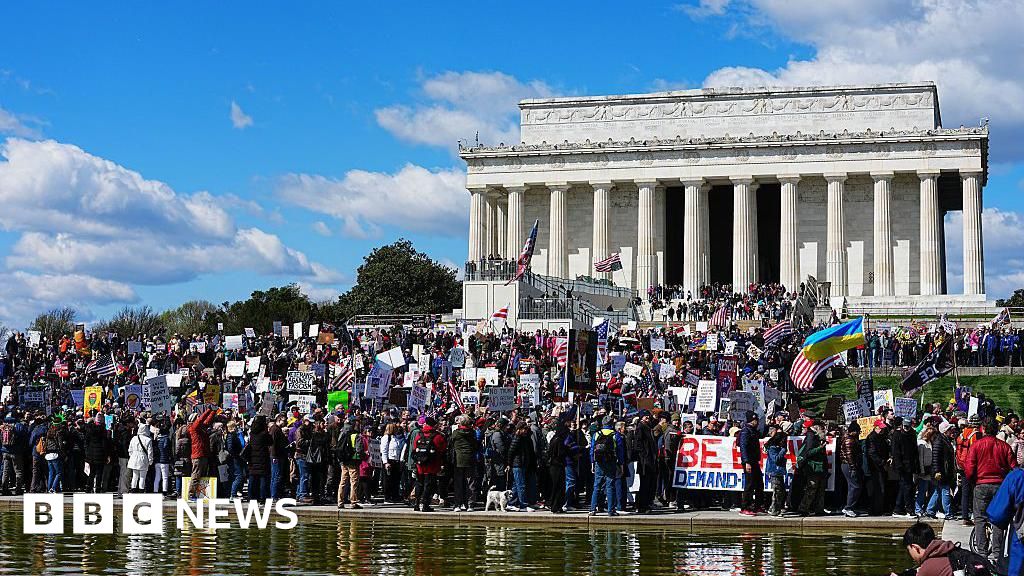
Nearly 7 million people attended the last No Kings rally in October; today nationwide No Kings protests are underway across nearly every major US city (New York, Washington DC, Los Angeles, Boston, Nashville, Houston) with international solidarity actions in Paris, London and Lisbon. Several states have mobilised the National Guard and demonstrators have massed on the National Mall, highlighting elevated political and social risk tied to disputes over the Iran war, federal immigration enforcement and expanded executive actions. For portfolios, expect localized operational disruptions and episodic volatility in politically sensitive sectors (defense, transport, municipal services, insurance), but limited immediate market-wide impact unless protests escalate or prompt major policy or enforcement actions.
Sustained, geographically dispersed civil unrest has asymmetric sectoral impacts: providers of non-lethal crowd-management hardware, body-worn cameras, and secure communications see multi-year demand optionality as municipal budgets reprioritize immediate public-safety procurement over longer lead-time capital projects. Conversely, downtown-centric real estate — especially office REITs with high commuter density and short-term retail tenants — faces a higher probability of accelerated vacancy and rent concessions if repeated episodes compress daytime foot traffic by a persistent 10-20% versus pre-event norms.
Near-term catalysts operate on distinct horizons. Over days-to-weeks expect volatility in local consumer-facing revenue (hotels/retail REVPAR declines of 5-15% in affected micro-markets) and transient widening of municipal credit spreads as cities fund police overtime and cleanup (a $50–200m shock forces budget reallocation in a mid-sized city). Over 3–12 months the policy reaction (federal vs state jurisdiction battles, legal actions) can institutionalize spending shifts into law-enforcement procurement and legal-defense services; over years the political fallout alters donor flows and regulatory regimes that affect sector profit pools.
The market consensus tends to price these events either as purely transient or as regime-shifting; reality will be a mix. That creates opportunities to pair short-duration event trades (capture immediate downside from foot-traffic shocks) with longer-dated longs in vendors of compliance, surveillance, and secure comms whose revenue growth path accelerates if procurement cycles shorten. Monitor three triggers that would flip this view quickly: credible de-escalation within 2–4 weeks, a heavy-handed federal crackdown causing national risk-off, or legal/legislative moves that materially constrain federal law-enforcement procurement.
AI-powered research, real-time alerts, and portfolio analytics for institutional investors.
Request DemoOverall Sentiment
neutral
Sentiment Score
0.00
