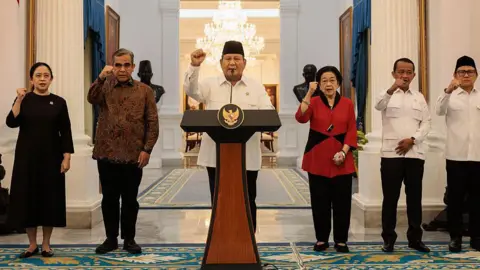
Indonesian President Prabowo Subianto has agreed to cut politicians' state-funded perks, including allowances, in response to escalating nationwide anti-government protests that have turned violent, resulting in three deaths and targeting the finance minister's residence. The unrest, initially sparked by a significant increase in parliamentary allowances and further inflamed by a ride-sharing driver's death involving police, poses a critical test for Prabowo's nascent administration. Despite these concessions, protest leaders suggest they are insufficient, signaling potential for continued political instability and implications for Indonesia's governance and economic outlook.
Significant political and social unrest in Indonesia is presenting the first major test for President Prabowo Subianto's new administration, introducing material risk to the country's stability. The protests, initially triggered by a new 50 million rupiah monthly allowance for lawmakers—a figure nearly ten times Jakarta's minimum wage—have escalated into violent clashes following the death of a ride-sharing driver involving a police vehicle. This has resulted in at least three fatalities, looting targeting the finance minister's residence, and a forceful police response. The government's attempt to quell the unrest by reversing some politician perks and imposing a travel moratorium has been dismissed by protest leaders as "not enough," indicating that deeper grievances concerning wages, taxes, and corruption remain unaddressed. The situation reflects a volatile political environment, underscored by a strongly negative sentiment score (-0.6) and a material market impact score (0.65), which could undermine the government's ability to pursue its economic and fiscal agenda effectively.
AI-powered research, real-time alerts, and portfolio analytics for institutional investors.
Overall Sentiment
strongly negative
Sentiment Score
-0.60
