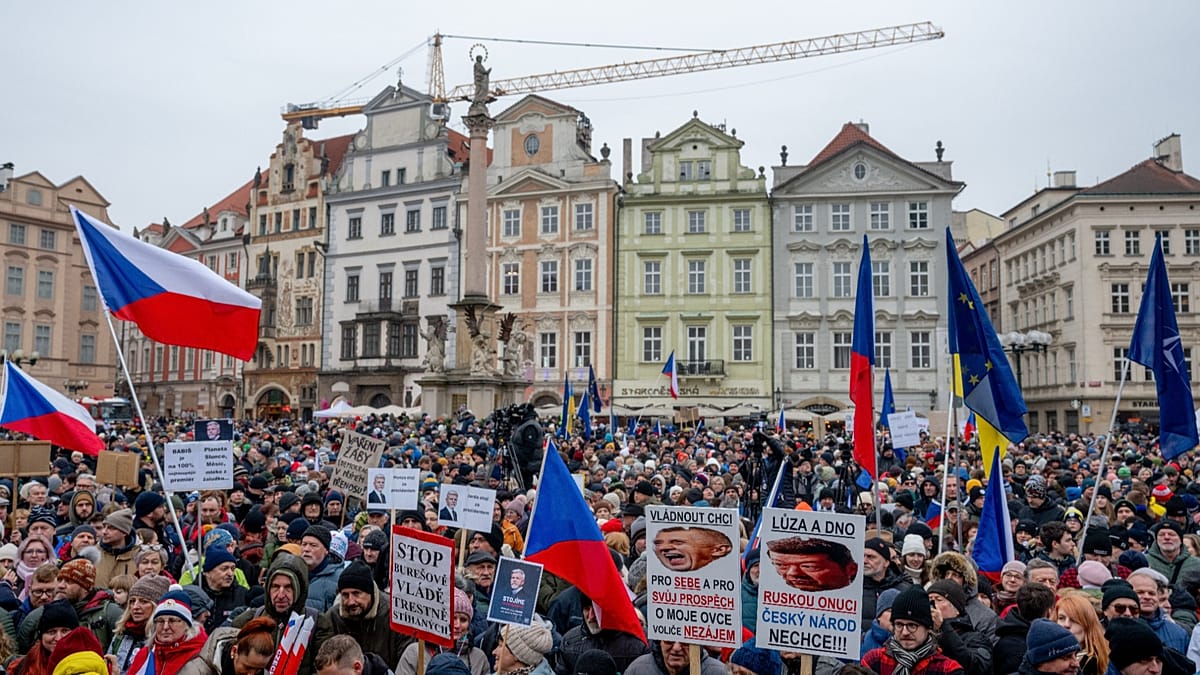
Prime Minister Andrej Babiš's new Czech coalition faces a no-confidence motion triggered by a dispute with President Petr Pavel after Pavel refused to appoint a Motorists for Themselves candidate as environment minister amid revelations of racist and offensive social-media posts. Deputy PM Petr Macinka, leader of that party, has accused the president of constitutional violations and threatened reprisals, while tens of thousands rallied in support of Pavel; Babiš's government currently holds a majority in the lower house and is expected to survive the vote. The coalition, sworn in December and built after October elections, includes nationalist partners whose agenda would reduce support for Ukraine and resist some EU policies, raising policy and geopolitical uncertainty that could weigh on investor sentiment toward Czech assets.
Market structure: The immediate winners are eurosceptic/anti-EU coalition backers (political, not direct corporate beneficiaries) while Czech sovereign credit and domestically exposed equities (banks, lenders, small-cap industrials) are first-order losers; expect a 10–50bp widening vs. German bunds and a 1–3% CZK depreciation if the standoff persists beyond a week. Competitive dynamics shift modestly: EU-funded projects and exporters to EU supply chains face higher political/regulatory friction, which can reduce pricing power for Czech industrial SMEs and raise borrowing costs for local corporates by ~50–150bp over 3–6 months.
Risk assessment: Tail risks include a government collapse/early election (low-probability now but 10–25% conditional on escalating threats) that could drive CZK -5% and +100–200bp sovereign spread widening; mid-term risk is gradual reduction in EU transfers reducing GDP growth 0.1–0.4%/yr over 2–4 years. Hidden dependencies: Czech banks’ asset quality is correlated to sovereign and SME stress; EU political measures (fund suspension) are non-linear catalysts. Key near-term catalysts: lower-house vote within 0–7 days and Wednesday’s Babiš–Pavel meeting.
Trade implications: Tactical plays: short CZK vs EUR via forwards or spot (target +1–3% in 1M; stop 0.5%), buy 1M EUR/CZK straddle to capture event vol (allocate 0.25–0.5% portfolio), and trim Czech bank names—reduce KOMB.PR and MONET.PR exposure by 30% in EM/CEE sleeves within 72 hours. Hedging: buy 5y Czech sovereign CDS (if available) or lengthen German bund futures (Eurex FGBL) by size equal to 1–2% portfolio. Rotate into defense/European large-cap defensives (VGK) and cash if vote outcome uncertain.
Contrarian angle: Markets may overprice downside—government currently has a majority and probability of survival >75%; if survival margin >20 votes, CZK could snap back 0.5–1.5% in 3–7 days, offering opportunity to buy back CZK or sell volatility. Historical parallels (short-lived Czech crises) suggest FX moves compress quickly; therefore scale positions: deploy 30–50% initial size, add on a confirmed 1% move or on official EU funding signals within 2–6 weeks.
AI-powered research, real-time alerts, and portfolio analytics for institutional investors.
Request DemoOverall Sentiment
mildly negative
Sentiment Score
-0.25
