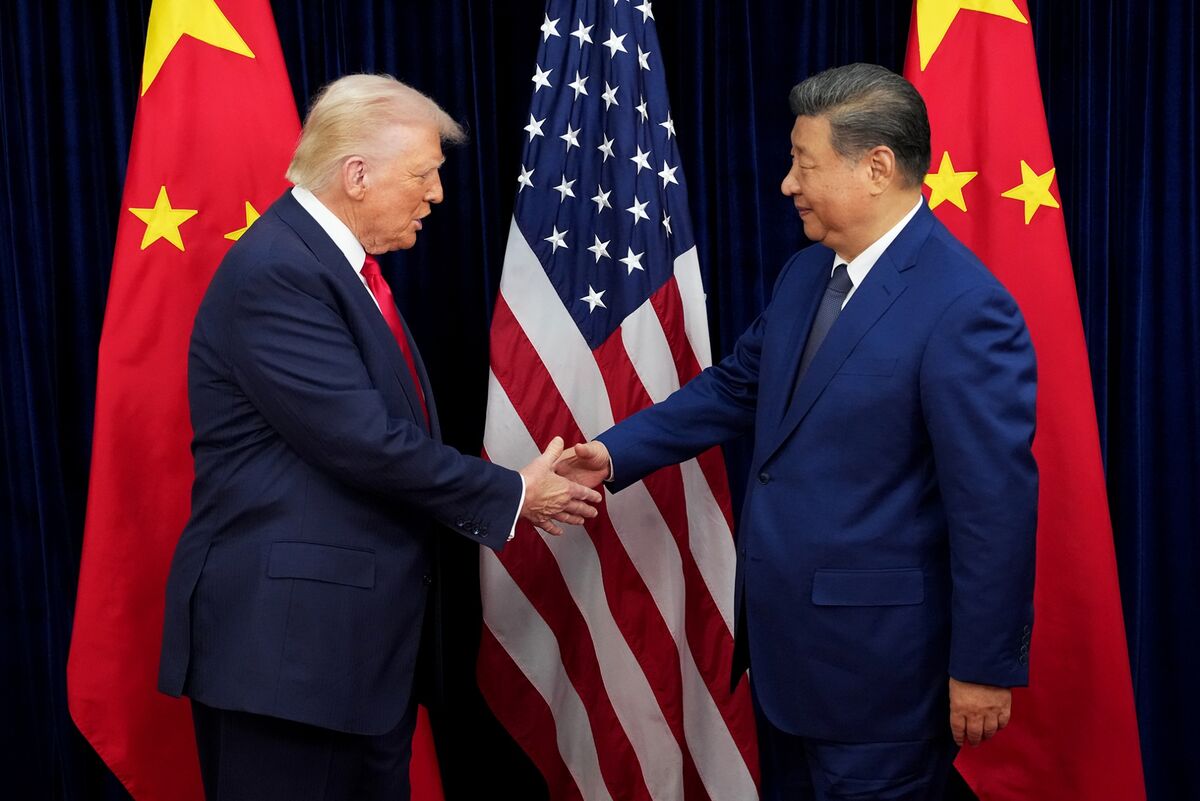
In an hourlong call with Donald Trump, Xi Jinping raised Taiwan — long the largest US–China flashpoint — by seizing on a diplomatic row with Japan to reassert Beijing’s sovereignty claims and frame them as part of the post‑World War II international order. The exchange brings Taiwan back onto the bilateral agenda and heightens geopolitical risk for investors, with potential implications for Asian equities, defense contractors, regional supply chains and safe‑haven flows should tensions escalate.
Market structure: A renewed Taiwan flashpoint selectively re-routes demand and pricing power toward defense contractors (LMT, NOC, RTX) and semiconductor capital-equipment suppliers (LRCX, AMAT, ASML) while pressuring Taiwan-heavy makers (TSM) and Asia-exposed supply-chain OEMs. Expect immediate risk-premia in shipping and insurance, upward pressure on advanced-node pricing (potentially +10–30% for constrained wafers over 3–12 months) and stronger bargaining power for firms able to onshore capacity. Cross-asset flows should favor Treasuries and gold (risk-off) and a stronger USD; oil may trade with risk premium spikes near conflicts.
Risk assessment: Tail risk — a kinetic disruption that halts >50% of advanced-node wafer output for weeks — would be a multi-quarter shock, plausibly cutting global electronics output by ~10–20% and forcing price inflation in semis and consumer electronics. Near-term (days) expect volatility spikes and FX pressure on CNY/CNH; short-term (weeks–months) see capex reallocation and CHIPS-related deal acceleration; long-term (years) entails durable decoupling and higher defense/infra budgets. Hidden dependencies include Japan’s stance, speed of export controls and CHIPS Act disbursements; catalysts include a military incident, new US/Japan basing, or fresh export sanctions.
Trade implications: Tactical trades: long 6–12 month calls on LMT/NOC and long semicap exposure (LRCX/AMAT) to capture capex re-shoring; hedge Taiwan semiconductor exposure with 3-month TSM puts or short EWT. Use options for immediate volatility (buy put spreads on TSM to cap premium and buy call calendars on LRCX to play elevated capex but limit theta). Rotate portfolio weight +3–5% into defense/semicap and reduce Asia-exposed discretionary/consumer tech by 3–6% over 4–12 weeks.
Contrarian angles: The market may overprice imminent full-scale conflict — probability remains <15% in next 12 months — creating mean-reversion entry points in TSM/ASML if prices dislocate >20% from pre-call levels. Conversely, policy responses (subsidies, CHIPS) could boost US/foreign fabs (MU, INTC) and semicap makers more than defense names in 12–36 months. Historical parallels (1996 Taiwan Strait, 2019–20 trade shocks) show sharp short-term drawdowns with multi-quarter recoveries in core tech; consider staged re-entry on 10–25% drawdowns rather than one-off buys.
AI-powered research, real-time alerts, and portfolio analytics for institutional investors.
Request DemoOverall Sentiment
moderately negative
Sentiment Score
-0.35
