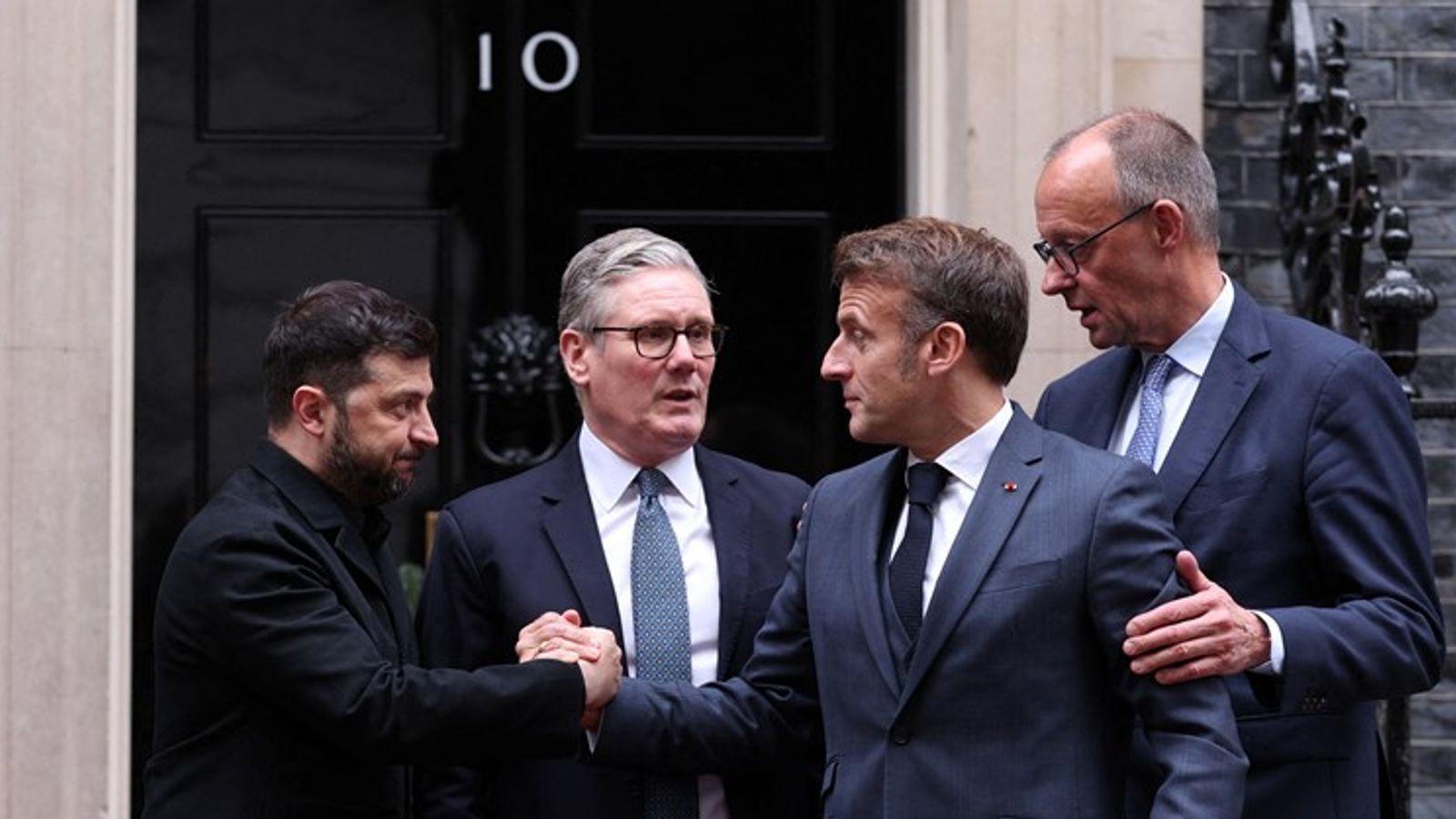
Leaders from more than 27 countries, including Ukrainian President Volodymyr Zelenskyy and US envoys Steve Witkoff and Jared Kushner, are meeting in Paris to design security guarantees and deterrence measures in the event of a post-ceasefire scenario, targeting five priorities: ceasefire monitoring, support for Ukraine's armed forces, multinational deployments (land/sea/air), contingency commitments, and long-term defence cooperation. The talks are complicated by transatlantic tensions after President Trump’s operation in Venezuela and comments about Greenland, and Zelenskyy warned that UK and French troop contributions are likely essential while many partners face parliamentary approval hurdles — sustaining geopolitical risk that could influence defence spending, sanctions dynamics, and regional risk premia.
Market structure: A post-ceasefire emphasis on multinational deployments and guarantees is a clear ramp for defense primes (LMT, RTX, GD, BAE.L) and ISR/munitions suppliers (LHX, NOC) with realistic upside of 10–30% in order-book visibility over 12–24 months. Energy and commodities (Brent, TTF gas) see asymmetric upside on renewed Russian leverage or disrupted exports—expect 10–25% price swings; airlines and European consumer cyclicals (IAG.L, AAL) are the principal losers as security risk premiums compress travel demand and fiscal cushions shift to defence spending. FX/bonds: political friction between US and Europe raises EUR downside risk (EUR/USD bias negative) and transient safe-haven bids into USD, JPY and Treasuries on 0–2 week shocks.
Risk assessment: Tail risks include direct NATO escalation or a Russia-driven energy cutoff—low probability but >5x portfolio drawdown if realized. Immediate (days) risk is volatility around Paris statements; short-term (weeks–months) hinge on parliamentary ratifications; long-term (1–3 years) is sustained capex and supply-chain constraints (semiconductors, propellants) that cap delivery. Hidden dependencies: US intra-administration unpredictability and parliamentary approvals; catalysts are formal US guarantees or UK/France troop commitments within 30–90 days.
Trade implications: Tactical overweight defense via ETFs/tops (ITA, LMT, RTX) and energy producers (XOM/CVX) with 6–18 month holds; pair trades long defense vs short airlines/European leisure (BAE.L long / IAG.L short) to capture relative re-rating. Use options to express directional view with defined risk: buy 9–12 month call spreads on LMT/ITA to capture upside while capping premium; consider buying LNG calls or XOM calls if Brent > $90 as scale-in trigger.
Contrarian angles: Markets may have front-loaded US defence exposure—small/mid-cap European subsystem suppliers (MBE/MBT analogues, LON small caps) are under-owned and can double on multi-year procurement; implied vol on majors could be rich—sell covered calls on LMT/RTX after a 10–15% rally to harvest premium. Historical parallel: post‑2014 Crimea saw a multi-year defense budget lift; failure to secure guarantees is the overlooked downside that would rapidly reverse this trade.
AI-powered research, real-time alerts, and portfolio analytics for institutional investors.
Request DemoOverall Sentiment
moderately negative
Sentiment Score
-0.25
