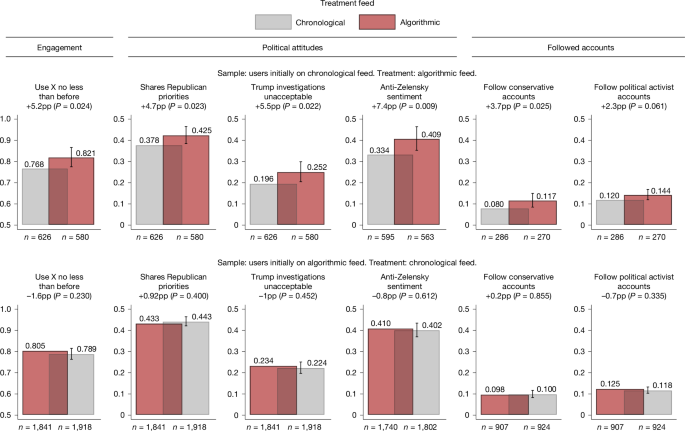
A randomized 7-week field experiment of 4,965 active US X users in summer 2023 finds that switching from a chronological feed to X’s algorithmic ‘For you’ feed materially increased engagement and shifted political attitudes toward conservative positions (e.g., conservative policy priorities +0.11 s.d., belief that Trump investigations are unacceptable +0.08 s.d., pro‑Kremlin attitudes +0.12 s.d.). The algorithm promoted conservative and activist content (conservative posts ~+2.9 pp; news organization posts −15.5 pp) and induced users to follow conservative activist accounts (followings +0.17 s.d.), producing persistent effects even after switching the algorithm off; reversing the change produced no symmetric effects. For investors, the findings signal reputational and regulatory risk vectors for the platform and underscore that feed design can meaningfully reshape user behavior and content exposure without immediate effects on polarization or partisanship metrics.
Market structure: X’s algorithmic tilt toward conservative, activist content creates a winner-takes-most dynamic in political attention: X and conservative creators gain engagement and persistent followings, while traditional news publishers lose referral reach (algorithm reduced news posts by ~58%). Finite attention means advertisers chasing political eyeballs will reprice inventory—willing to pay premiums for targeted, high-engagement slots ahead of election cycles (price pressure upward by low double digits in niche political inventory over 6–12 months). Cross-asset: higher political-news-driven volatility can lift equity implied vols (media/social names), push safe-haven bonds/FX flows marginally into Treasuries and USD during episodic ad boycotts or hearings.
Risk assessment: key tail risks include regulatory action (content/ad rules, Section 230-style changes) with a 10–30% probability over 12 months that could force ad-spend cuts of 5–15% in the sector, reputational advertiser boycotts that cluster in days–weeks, and algorithm updates that flip engagement patterns. Immediate (days) risks are headlines/advertiser pullbacks; short-term (months) risks are reallocation of Q2–Q4 ad budgets; long-term (years) risk is structural audience migration and enduring policy scrutiny. Hidden dependencies: advertisers’ sensitivity to perceived bias and platform follow-network stickiness can lock in asymmetric effects even after algorithm changes.
Trade implications: favor large, diversified ad/tech franchises that can absorb political inventory rotation—GOOGL benefits from intent-based search and YouTube audience scale; META faces regulatory and reputational downside, especially if advertisers pull political spend. Tactical options: position with directional equity plus options to asymmetrically hedge for event risk (advertiser boycotts, hearings). Sector rotation: underweight legacy news/media exposure and overweight ad-measurement/identity solutions and diversified digital ad platforms over 3–12 months.
Contrarian angle: consensus that Meta will lose secular share may be overstated — Meta’s scale, diversified engagement products and enterprise ad tools can recapture budgets; historical parallel: incumbents (Facebook vs. Snap/TikTok) initially lost political/engagement niches but adapted product and ad offerings. Mispricing risk: short-term spikes in negative sentiment create opportunities to buy META on 10–20% pullbacks if no regulatory fines materialize within 90 days. Unintended consequence: heavy regulation could raise barriers to entry and re-consolidate ad power in GOOGL/META over multi-year horizons.
AI-powered research, real-time alerts, and portfolio analytics for institutional investors.
Request DemoOverall Sentiment
mildly negative
Sentiment Score
-0.25
Ticker Sentiment
