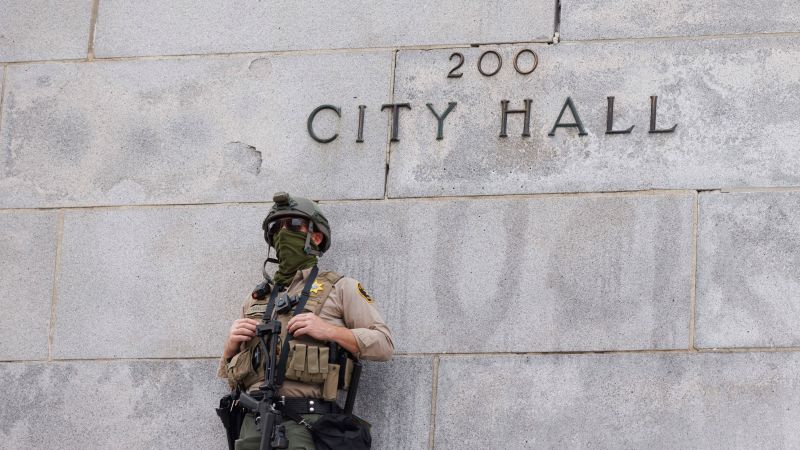
The Trump administration filed suit in the U.S. District Court for the Central District of California to block a state law, due to take effect in January, that prohibits most law-enforcement facial coverings during official duties; DOJ argues the measure unconstitutionally attempts to regulate federal officers and endangers agents by stripping a safety tactic, with Attorney General Pam Bondi saying masks protect against doxxing and harassment. California Governor Gavin Newsom enacted the law after summer immigration raids by masked, unmarked federal agents and framed it as restoring accountability and protecting immigrants; the statute — reportedly the first of its kind and subject to exceptions for undercover, medical and tactical gear — creates a direct federal‑state legal clash that could constrain how federal immigration enforcement operates in California and set a broader precedent on state limits over federal law enforcement practices.
The Department of Justice filed suit in the U.S. District Court for the Central District of California seeking to block a California law, signed in September and slated to take effect in January, that prohibits most law-enforcement facial coverings during official duties; the statute bars neck gaiters, ski masks and other facial coverings for local and federal officers while allowing exceptions for undercover agents, medical masks and tactical gear. Attorney General Pam Bondi argued masks are a necessary precaution to protect federal agents from doxxing and harassment, while Governor Gavin Newsom framed the law as a response to masked, unmarked federal immigration raids; the Associated Press called the statute the first of its kind in the U.S. John Sandweg, former acting ICE director, warned publicly that unmarked, masked arrests create public-safety risks.
The suit asserts the law is an unconstitutional attempt by the state to regulate federal officers, creating a direct federal–state legal clash that could constrain how federal immigration enforcement operates in California and potentially set a broader precedent. The article notes there is currently no federal policy on when officers may cover their faces, so the litigation outcome and any subsequent DOJ guidance will determine operational practices.
Immediate market impact is assessed as minimal (market_impact_score 0.1), but the case raises policy and litigation risk with political salience ahead of elections; investors should monitor court filings and agency responses for signs of broader regulatory or operational shifts.
AI-powered research, real-time alerts, and portfolio analytics for institutional investors.
Request DemoOverall Sentiment
neutral
Sentiment Score
0.00
