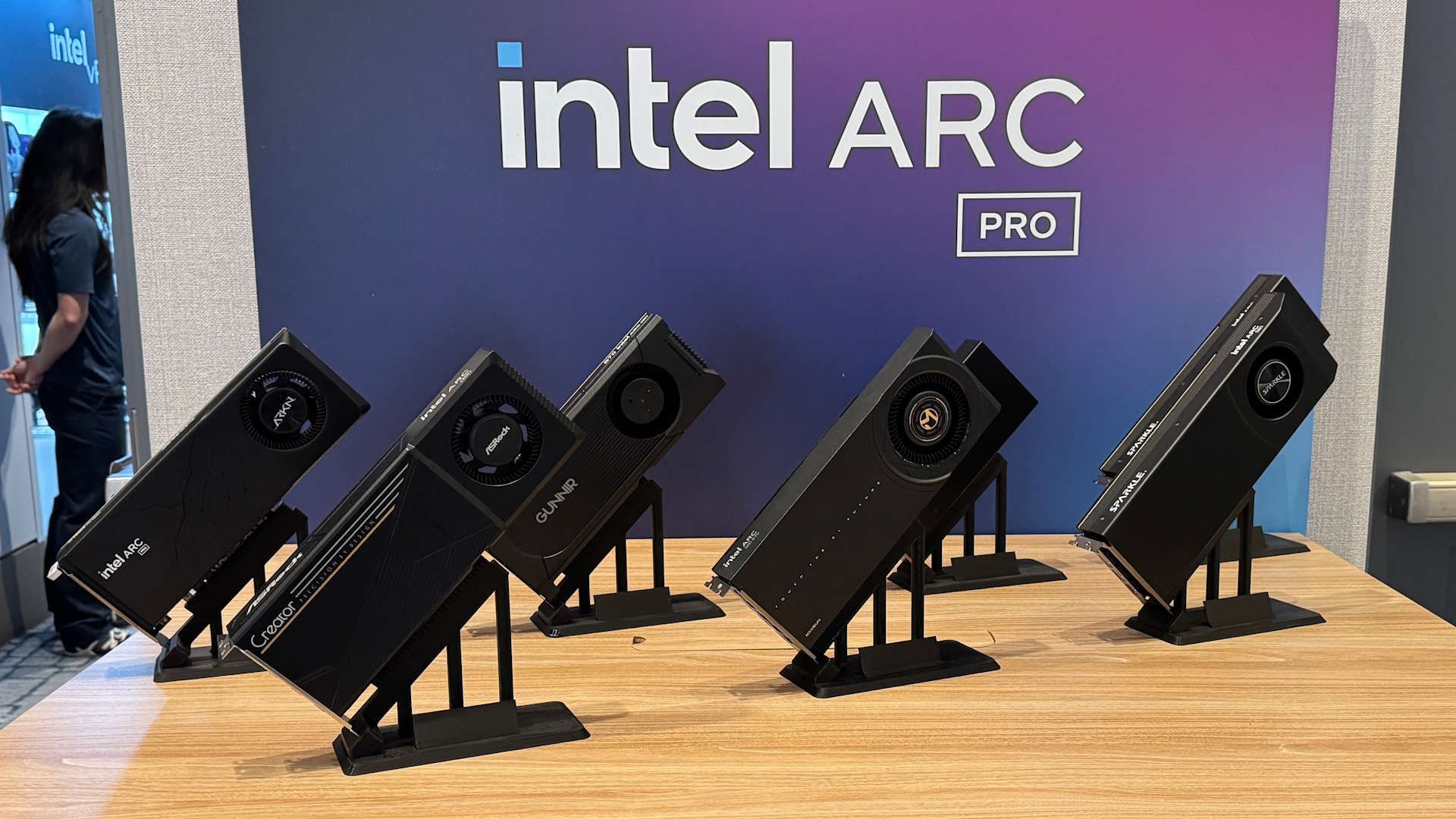
Intel launched Arc Pro B70 and B65 GPUs with 32GB GDDR6 (19 Gbps) on a 256-bit bus delivering 608 GB/s; the B70 has 32 Xe cores at 2,800 MHz for a theoretical 22.9 TFLOPS FP32, a 160–290W power envelope, and starts at $949 (reference). The B65 retains 32GB/608 GB/s but drops to 20 Xe cores; price not announced and availability is mid‑April. Intel positions the B70 against Nvidia's $1,800 RTX Pro 4000 (24GB) and AMD's ~$1,299 Radeon AI Pro R9700, emphasizing lower cost-per-token and multi-GPU scaling (Intel highlighted up to four‑GPU configurations) but acknowledges software and ecosystem limitations versus Nvidia/CUDA and broader precision support. Investment implication: the cards could pressure pricing and attract on‑prem AI/pro buyers seeking dense VRAM at lower entry cost, but adoption risk remains due to software compatibility, precision-format limitations, and narrower multi‑GPU scaling.
Intel’s latest product push is less about raw gaming parity and more about shifting an economic inflection for on‑prem inference: cheaper entry points for larger, memory‑heavy configurations make closed‑network LLM deployments materially more attractive to SMBs and labs that previously relied on cloud spot instances. Expect near‑term demand to bifurcate — experimental adopters will buy low‑cost local servers to avoid cloud token bill volatility, while production customers will stick with established software ecosystems that scale horizontally.
Second‑order supply effects matter: board partners, GDDR6 suppliers, and server integrators stand to see order volatility as buyers that formerly purchased single high‑end accelerators switch to multiple mid‑range units or denser local racks. Conversely, companies that sell multi‑GPU chassis, NVLink‑style interconnects, or CUDA‑native orchestration software could see slower uptake on non‑CUDA boxes, preserving incumbents’ pricing power in scaled deployments.
Timing and software maturity are the primary gating factors. Hardware availability alone will produce only a temporary uptick in trials; durable share gains require driver stability, quantization toolchains, and multi‑GPU orchestration to be robust — a 6–12 month runway is realistic before any measurable displacement of incumbent server GPU spend. The clearest reversal risk is ecosystem lock‑in: if major ISVs or model providers deprioritize non‑CUDA stacks, adoption stalls regardless of hardware cost advantage.
AI-powered research, real-time alerts, and portfolio analytics for institutional investors.
Request DemoOverall Sentiment
mildly positive
Sentiment Score
0.20
Ticker Sentiment
