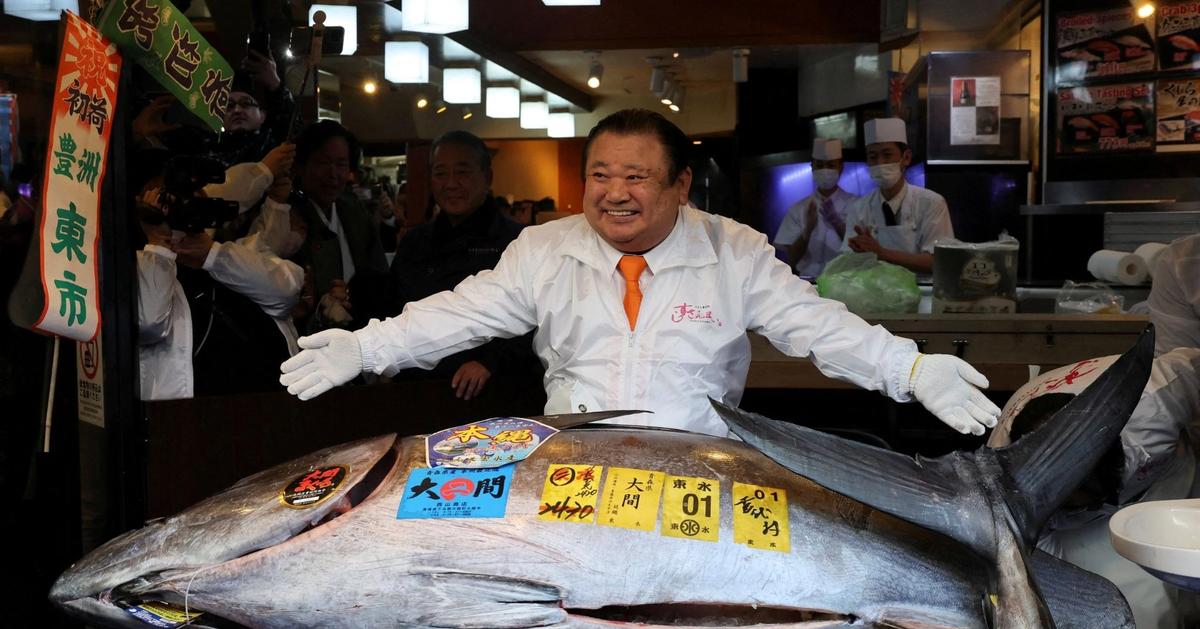
A 535-pound bluefin tuna fetched a record ¥?3.24 million (reported $3.24 million) at Tokyo’s Toyosu market, bought by Kiyoshi Kimura, owner of the Sushizanmai restaurant chain; the fish was caught off Oma and the bid exceeded Kimura’s 2019 record. Kimura said he will sell servings at the chain’s usual price to make the catch widely available, a marketing coup that underscores strong consumer demand for premium seafood but is unlikely to have meaningful market or financial impact beyond brand and PR benefits.
Market structure: The headline $3.24M sale (≈$6,056/lb for a 535‑lb fish) is a marketing-driven price extreme that directly benefits vertically integrated seafood suppliers, premium sushi operators and auction houses via PR-driven demand; it disadvantages commodity buyers and mid‑market restaurant chains that compete on price. Pricing power is concentrated in scarce high‑grade bluefin; expect short, sharp retail/PR price spikes rather than broad wholesale re‑pricing unless sustained demand emerges over quarters. Cross‑asset: negligible impact on JGBs/FX; small positive impulse to seafood equity multiples and spot tuna indices over 0–3 months, with limited option vol pick‑ups for specialist names in Japan (1332/1333/3563/2695 tickers).
Risk assessment: Tail risks include regulatory quota cuts or stricter sustainability labeling within 3–24 months (could lift wholesale prices but constrain volumes), and reputational/ESG campaigns that reduce demand for unsustainably sourced bluefin. Near term (days–weeks) risk is ephemeral media attention; medium term (3–12 months) supply shocks or tariff/quota outcomes are material; long term (years) is stock depletion and permanent premiumization or substitution to farmed alternatives. Hidden dependency: headline sales can be loss‑leading marketing spend for restaurants, masking margin pressure. Key catalysts: Japanese New Year demand (next 4–8 weeks), ICCAT/ regional fisheries meetings over next 6–12 months.
Trade implications: Favor listed, integrated processors with scale (Nissui 1332.T, Maruha 1333.T) for 3–12 month exposure and avoid non‑integrated, low‑margin operators. Tactical options: buy 3‑month call spreads on 1333.T (size 1–2% AUM, target +10–15%) to capture near‑term premiumization; consider a 6–12 month long in 1332.T (2–3% AUM) with 8% stop. Pair trade: long 1333.T, short a broad Japan restaurant operator ETF or non‑integrated chain (e.g., 3563.T if valuation disconnect) to isolate seafood price capture.
Contrarian angles: The market may dismiss this as PR, understating structural premiumization of provenance-driven seafood; conversely, it could be overdone if ESG/quotas force substitution away from bluefin. Historical parallels (2019 record auctions) show short‑term share rallies that faded—use quant triggers (volume‑adjusted price moves >15% or quota cuts >10%) to reallocate. Unintended consequence: sustained headline prices could accelerate farmed tuna and alternative protein investments, creating a 12–36 month disruption risk to wild‑catch processors.
AI-powered research, real-time alerts, and portfolio analytics for institutional investors.
Request DemoOverall Sentiment
mildly positive
Sentiment Score
0.25
