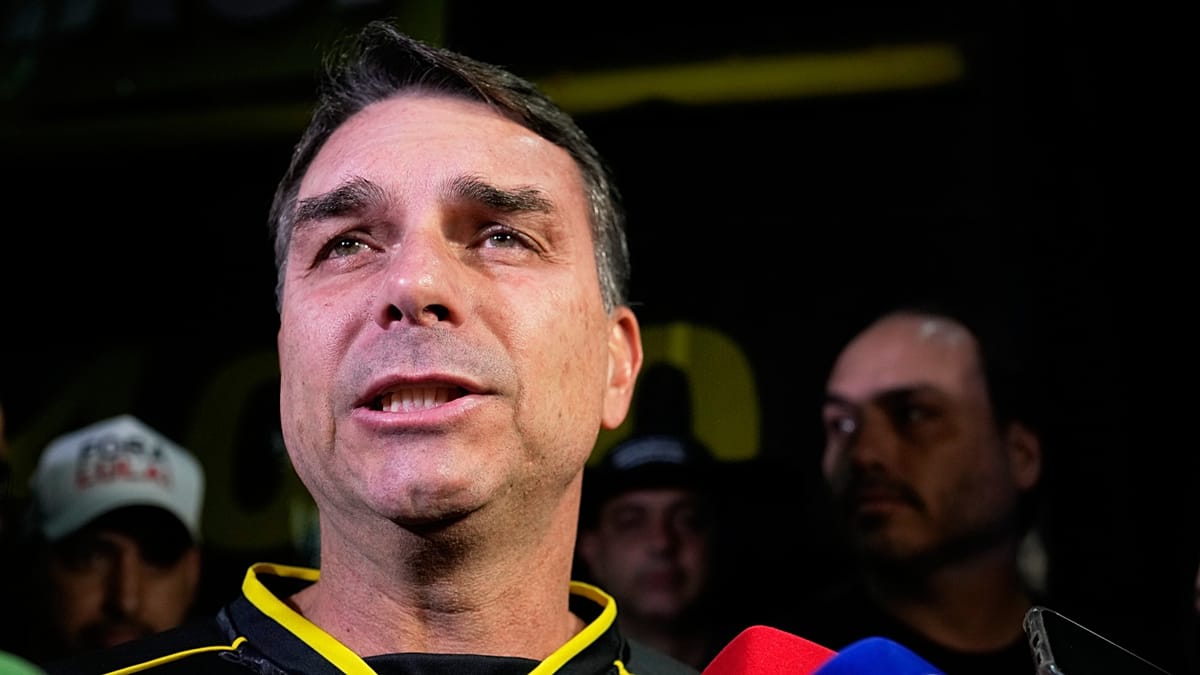
Senator Flávio Bolsonaro announced he has been endorsed by his father, former President Jair Bolsonaro, to seek the presidency in 2026, positioning him as a leading successor amid intra-party rivalry with São Paulo Governor Tarcísio de Freitas. Jair Bolsonaro is serving a 27-year prison sentence for plotting a post‑2022 coup, has been barred from running until 2030, and Flávio — a 2018-elected senator — has faced (dismissed) embezzlement allegations; the endorsement heightens political uncertainty in Brazil and could influence investor risk perception ahead of the 2026 election cycle.
Market structure: Flávio Bolsonaro’s endorsement tightens political polarization and raises near-term risk premia for Brazil. Immediate beneficiaries are safe-haven assets (USD, gold) while Brazil equities (MSCI Brazil/EWZ) and domestic banks (Itau ITUB ADR) face downside pressure as sovereign CDS and 10y yields could widen 50–150bps in a stress scenario; BRL depreciation of ~3–8% is a credible short-term move if protests or legal escalations intensify.
Risk assessment: Tail risks include large-scale street unrest, broader institutional crackdowns, or contagion to corporate credit leading to forced deleveraging; low-probability but high-impact sovereign stress or further attempts to delegitimize institutions could push EMBI spreads >300bps. Time horizons: days = volatility spikes; weeks–months = capital outflows and CDS widening; quarters+ = potentially lower FDI and slower capex if rule-of-law concerns persist. Hidden dependencies include commodity revenue insulation (soy/iron ore receipts) which cushions fiscal stress but delays private investment.
Trade implications: Tactical trades should be volatility-driven and hedged — short Brazil beta (EWZ) and buy USD/BRL protection while increasing allocations to US Treasuries and gold as carry sinks. Use options to cap downside cost (3-month USD/BRL calls 5% OTM, 1–3 month EWZ put spreads); watch CDS, BRL, and 10y yield moves as execution triggers (act within 2 weeks, reassess at 4–8 weeks).
Contrarian angle: The market may underprice a scenario where Bolsonaro-aligned politics pursue investor-friendly privatizations, which could boost infrastructure and mining names if political risk stabilizes. Consider small, conditional opportunistic longs in high cash-generative exporters (e.g., VALE ADR) if BRL re-strengthens by >3% and 10y yields drop >100bps; this trade is asymmetric but should be sized <=1% NAV given regime risk.
AI-powered research, real-time alerts, and portfolio analytics for institutional investors.
Request DemoOverall Sentiment
moderately negative
Sentiment Score
-0.32
