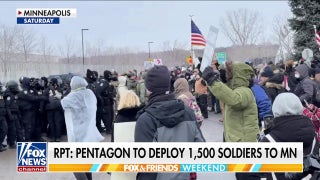
U.S. officials are reportedly preparing roughly 1,500 troops for potential deployment to Minnesota, according to The Washington Post citing unnamed defense officials, though neither the White House nor the Pentagon have confirmed plans. The report follows President Trump’s threat to invoke the Insurrection Act amid confrontations between federal agents and protesters in Minneapolis–St. Paul, where about 3,000 federal agents are already present; Trump later said he did not see an immediate need to invoke the law. While the situation raises heightened political and law-enforcement risk and could exacerbate state-federal tensions, there is no confirmed deployment and the immediate direct market impact is likely limited and localized.
Market-structure: Federal troop deployment rhetoric benefits defense primes (LMT, RTX, GD) and tactical/security suppliers and ICE/detention contractors (GEO, CXW) via policy optionality; losers are localized MN municipal credit and firms with concentrated Twin Cities operations (regional banks, some insurers) as perceived political/legal risk elevates borrowing costs and operating friction for weeks to quarters. Competitive dynamics shift marginally: incremental gov't contracting tailwinds raise short-term order probability but not enough to change market share for majors; smaller specialist contractors and private security firms could see outsized revenue re-rates if deployments persist >30 days.
Risk assessment: Tail risks include nationwide invocation of the Insurrection Act or escalation that triggers >5% S&P drawdown, prolonged legal battles raising MN GO muni spreads 10–40bp, and reputational/regulatory backlash to contractors. Time horizons: immediate (days) = volatility spike (VIX +20–50%), short-term (weeks/months) = muni spread widening and selective capex/orders, long-term (quarters) = budget and policy shifts that could reprice ICE/defense contractors. Hidden dependencies: state legal action, DOJ funding, and media incidents are binary catalysts that amplify market moves; watch court filings and federal contract awards.
Trade implications: Tactical longs in defense and selective ICE contractors with capped downside and short/hedged exposure to MN-centric credits make sense; pair trades (long LMT/short USB or regional bank exposure) capture safe-haven vs local-credit divergence. Options/volatility plays (short-dated VIX call spreads, long-dated protective puts on regional bank names) are efficient for asymmetric risk transfer around expected catalysts (14–60 day window).
Contrarian angles: Consensus underestimates credit contagion to MN munis and regional banks — markets treat this as political noise despite quantifiable budget/legal risks; private-prison/ICE contractors appear underpriced for a modest surge in enforcement activity. Historical parallel: 1992 LA unrest caused localized credit pain but limited national equity drawdown; however modern media and polarized politics increase tail probability. Unintended consequence: federal intervention could provoke prolonged legal/contract uncertainty that delays payments to contractors for 1–6 months, reducing near-term free cash flow despite higher future revenues.
AI-powered research, real-time alerts, and portfolio analytics for institutional investors.
Request DemoOverall Sentiment
moderately negative
Sentiment Score
-0.35
