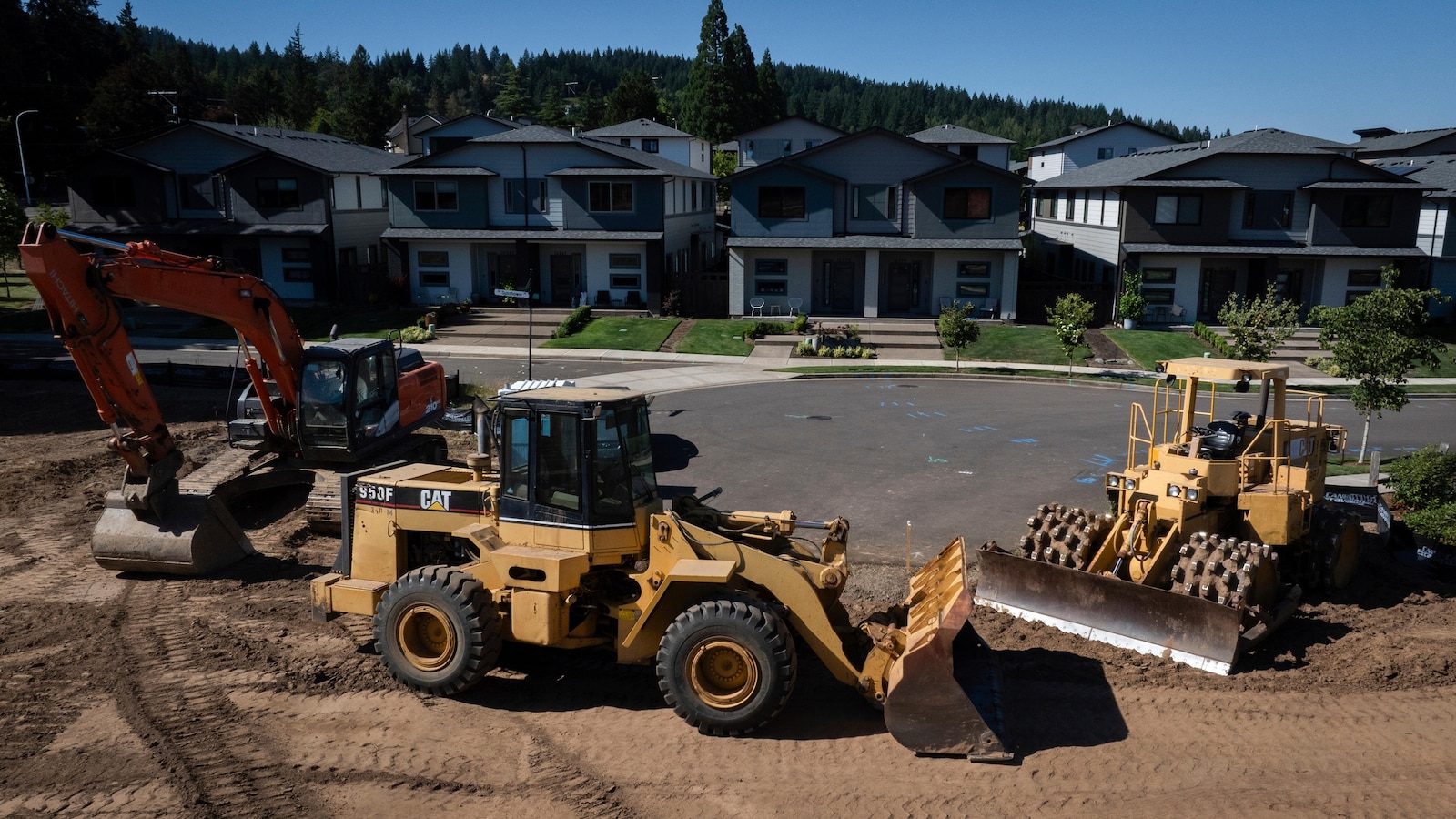
President Trump has publicly prioritized keeping home prices elevated to protect existing homeowners while opposing policies that would boost supply, even as single-family building permits fell 9.4% year-over-year to an annual rate of 876,000 in October. Administration actions include lobbying the Fed for rate cuts and directing Fannie Mae and Freddie Mac to buy at least $200 billion in mortgage securities, a move aimed at lowering mortgage rates but with potential inflationary consequences; analysts say construction would need to rise 50–100% over three years to stabilize price gains. The stance raises political trade-offs ahead of midterms by favoring older homeowners over younger buyers and creates modest near-term policy risk for housing, rate-sensitive financials and credit markets.
Market structure: Policy signals favor existing homeowners (upside to owner-occupied equity wealth) while near-term supply remains constrained — single-family permits down 9.4% y/y to a ~876k annualized pace — supporting prices and pricing power for sellers and suburban builders. If the administration succeeds in pushing Fed rate cuts or $200bn+ MBS purchases, shorter-term mortgage rates and 30y fixed coupons should compress, boosting mortgage originators, MBS-sensitive REITs and homebuilder order books; conversely, any legislative ban on large institutions buying houses is a direct negative for institutional landlords (INVH, AMH) and iBuying intermediaries.
Risk assessment: Tail risks include a legislative ban on institutional home purchases, mass deportation scenarios reducing demand, or an inflation surprise that forces rates higher (10y > 4.0%) and collapses builder multiples. Time horizons: days–weeks react to FOMC statements/CPI prints; months see permit and builder earnings cycles; quarters–years require a sustained 50–100% rise in single-family construction to neutralize price gains. Hidden dependencies: local zoning, labor and lumber costs, and secondary market liquidity for MBS.
Trade implications: Favor convex, capped-risk longs into potential Fed easing: selectively long homebuilder call spreads (DHI, LEN) and 9–12m call structures on mortgage REITs (NLY) sized 1–3% per idea; short 1–2% positions in institutional landlord names (INVH, AMH) or buy puts if Congress signals curbs. Use XHB long vs INVH short pair to express rotation from institutional rental to new supply/ownership; hedge macro with 3–6m protection on financials if 10y > 4.0%.
Contrarian angles: Consensus focuses on politics; miss is that modest rate cuts + MBS buying could sharply re-lever demand without increasing supply — a win for builders and mortgage REITs for 6–12m even if supply solutions arrive later. Reaction to permit weakness may be overdone in builder equities — use tight call spreads instead of outright longs. Unintended consequence: Fed easing + fiscal support could boost CPI -> push long-term yields higher and crush mortgage-sensitive trades, so size and duration discipline matter.
AI-powered research, real-time alerts, and portfolio analytics for institutional investors.
Request DemoOverall Sentiment
mildly negative
Sentiment Score
-0.25
