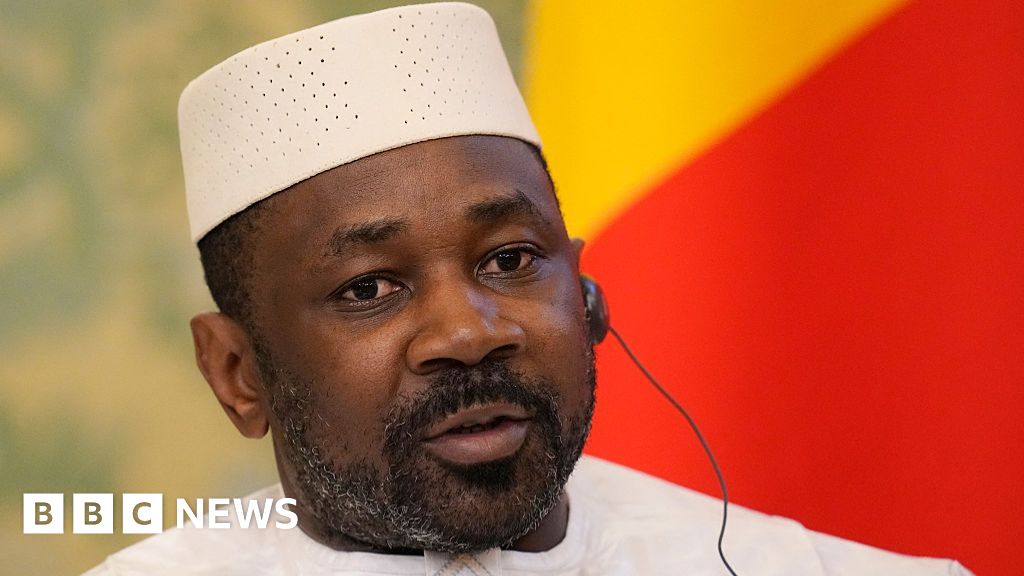
Mali's junta leader Assimi Goïta has appointed himself defence minister after predecessor Sadio Camara was killed in a suicide truck bombing amid coordinated jihadist and separatist attacks. The offensive has triggered a partial blockade on Bamako, forced withdrawals from Kidal, and raised doubts about the military government's grip on power. The unrest also highlights broader regional instability across Mali, Niger, and Burkina Faso, where government control remains limited despite joint military operations.
The immediate market implication is not a direct commodity or asset-price shock, but a worsening of sovereign execution risk across the Sahel. When a regime shifts scarce leadership bandwidth from internal security to internal control, the next-order effect is usually degraded counterinsurgency coherence, slower procurement, and higher leakage in military logistics; that tends to extend the duration of disruption rather than simply intensify it. For investors, the more important channel is regional contagion. Mali sits inside a fragile transport and trade corridor linking landlocked Sahel states to coastal ports; persistent attacks raise insurance premia, delay cross-border freight, and can force rerouting through already constrained paths in Senegal, Côte d’Ivoire, and Ghana. The result is a slow burn hit to local banks, telecoms, fuel distributors, and infrastructure operators with exposure to the broader West African corridor, even if headline equity indices initially shrug. The setup is also a credibility shock for the junta bloc. If security forces are perceived as penetrable by insider threats, recruitment quality, officer loyalty, and foreign partner confidence deteriorate over months, not days. That raises the odds of more arrests, purges, and emergency decrees—politically useful, but economically corrosive—and it increases the probability that any near-term tactical gains are unsustainable without a major external security backstop. Contrarianly, the consensus may be underestimating how quickly these regimes can harden politically after an attack. A short-term rally in incumbency control is possible if the leadership uses the crisis to centralize command and ration information, so the investable thesis should not be linear instability but rising volatility and a lower growth path for the entire corridor.
AI-powered research, real-time alerts, and portfolio analytics for institutional investors.
Overall Sentiment
strongly negative
Sentiment Score
-0.75
