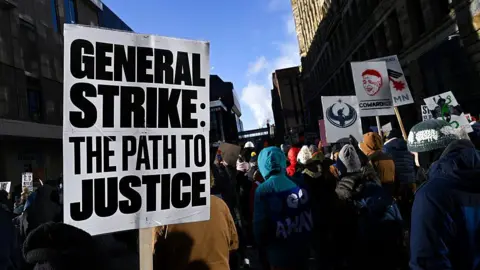
Hundreds of Minnesota businesses, including restaurants and retail shops, shut on Friday and thousands of protesters turned out in response to a multi-week ICE enforcement operation dubbed "Operation Metro Surge," with at least one restaurateur reporting sales declines of more than 30% over three weeks. The action coincided with mass demonstrations, arrests of clergy at the airport, reports of detained children, and political escalations including calls for greater federal-local coordination and resignations within federal offices, signaling localized but material hits to consumer demand, staffing and revenues and rising political and regulatory risk for regional operators.
Market structure: Local consumer-facing businesses (independent restaurants, tattoo parlours, shops) are direct losers — expect 20–40% near-term foot-traffic declines in impacted Minneapolis ZIP codes and measurable sales-volume leakage to adjacent suburbs over 2–8 weeks. Winners include private security, legal services and federal contractors (e.g., LDOS, CACI) who see incremental short-term demand for logistics/support; regional airline hub operators (Delta, DAL) are exposed to MSP disruptions and likely see 3–8% revenue risk if operations/scheduling disruptions persist beyond two weeks.
Risk assessment: Tail risks include escalation to sustained civil unrest (>3 months) that could depress local GDP contribution by low-single-digits and stress municipal revenues, widening Hennepin County muni spreads by 50–150bp. Immediate risks (days–weeks) are episodic volume shocks and elevated implied volatility in airline and regional retail stocks; medium-term (1–6 months) risks are legal/regulatory responses that raise compliance costs for employers and travel providers.
Trade implications: Implement tactical, time-boxed hedges: short-dated airline downside (3-month puts on DAL sized to 0.5–1% NAV) and go long 6-month call spreads on LDOS/CACI sized 1–2% to capture potential incremental federal contracting. Rotate 2–4% from XRT/XLY into defensive cash-flow names or short-duration national munis (MUB) to hedge a localized sales-tax hit; pair trade long LDOS vs short DAL for relative exposure to federal deployments vs consumer demand shock.
Contrarian angles: Consensus may overstate national contagion — historical parallels (Ferguson 2014) show sharp local revenue drops that largely normalize in 6–12 weeks, creating snap-back opportunities in oversold travel/retail names. Risk: heavy federal deployments could politicize and delay procurement, so avoid single-name concentration in contractors and prefer diversified exposure or buy-call spreads to cap premium spend.
AI-powered research, real-time alerts, and portfolio analytics for institutional investors.
Request DemoOverall Sentiment
moderately negative
Sentiment Score
-0.35
Ticker Sentiment
