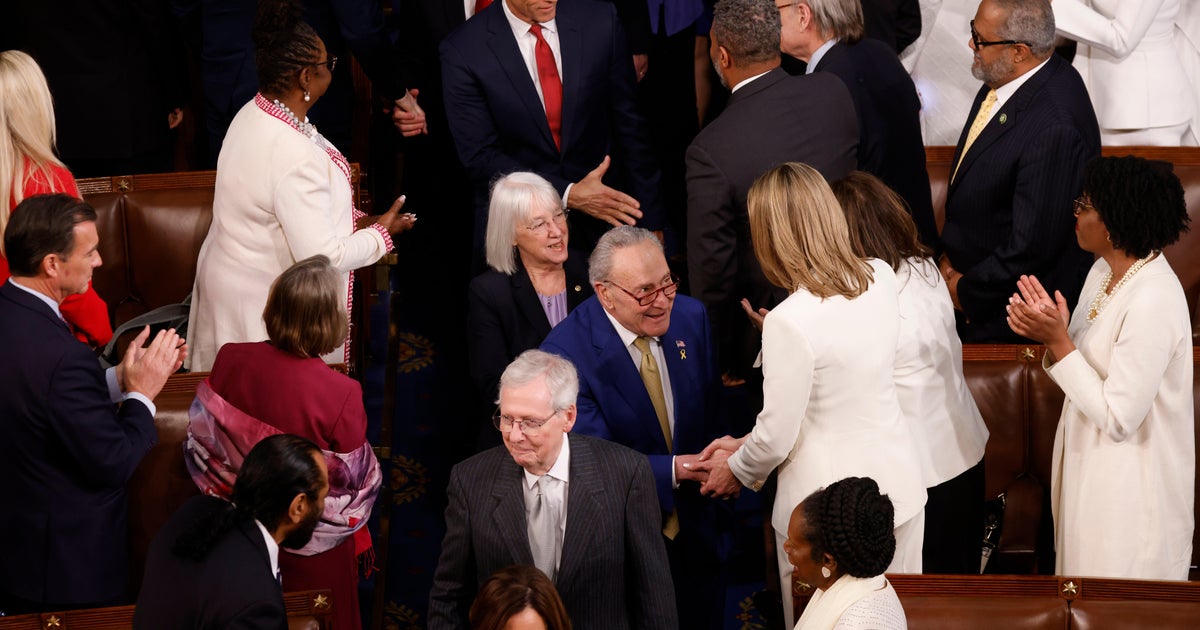
Dozens of House and Senate Democrats are planning to boycott or otherwise refrain from visibly supporting President Trump's State of the Union address, instead attending alternate events such as the “People’s State of the Union” on the National Mall and a “State of the Swamp” program at the National Press Club. House Minority Leader Hakeem Jeffries framed attendance as either silent defiance or nonattendance; notable participants and non-attendees include Sens. Ed Markey, Jeff Merkley, Ron Wyden, Ruben Gallego, and Reps. Pramila Jayapal and Alexandria Ocasio‑Cortez, while some Democrats will use invited guests (including an Epstein survivor) to make statements. The actions are largely symbolic and reflect partisan positioning rather than an immediate policy or market-moving event, but they underscore continuing legislative polarization that could influence future political risk assessments.
Market structure: This is an idiosyncratic political media event — primary winners are live-broadcast and partisan media outlets (FOX Corp - FOXA/FOX, News Corp - NWSA) which can capture short-term ad CPM uplifts; losers are legacy competitors that lose viewership share (Warner Bros Discovery - WBD, DIS to a lesser extent). Expect event-night CPMs to rise ~5–15% for outlets carrying aligned audiences, producing a measurable but small revenue bump (order +0.1–0.5% of quarterly revenue for large networks) over 1–5 trading days.
Competitive dynamics & supply/demand: Live political content supply is fixed; demand concentrates on partisan platforms, pushing relative pricing power to niche broadcasters and programmatic sellers tied to them (short-term advantage to FOXA/FOXA advertising inventory). Tech ad platforms (GOOGL, META) see headline-driven reallocations but not structural displacement unless sustained campaign-level boycotts emerge over months.
Cross-asset & risk: Direct market impact is muted; cross-asset effects are second-order — modest intraday equity volatility (S&P ±0.5–1%) and transient safe-haven flows that could move 10y yields by 5–15bp if protests escalate. Tail risks (days–weeks) include escalation into sustained demonstrations or legal actions that trigger risk-off (S&P -3–5%, 10y yields -20–50bp) and regulatory pressure on tech over content moderation (quarters).
Trade catalysts & hidden deps: Watch legal filings, committee actions, and midterm messaging over the next 30–90 days — any formal investigation or indictment materially raises political volatility and reallocates ad dollars and regulatory risk. Algorithmic/social amplification can turn a low-prob event into a persistent narrative within 72 hours; that’s the primary catalyst to widen moves beyond media names.
AI-powered research, real-time alerts, and portfolio analytics for institutional investors.
Request DemoOverall Sentiment
neutral
Sentiment Score
0.00
