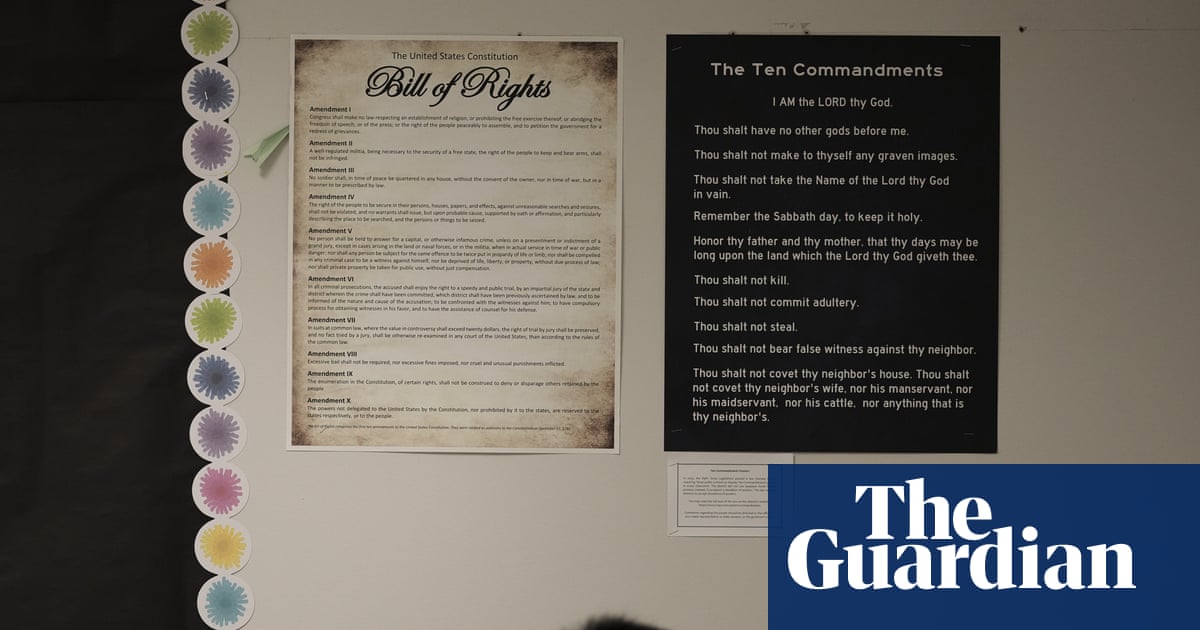
A US appeals court ruled 12-6 that Texas can require the Ten Commandments to be displayed in public school classrooms, lifting a lower-court block on the law. The decision also reinforces a similar Louisiana ruling and increases the chance of a future US Supreme Court clash over church-state separation. The case is politically significant but carries limited direct market impact.
This is a small but meaningful institutional signal that the current Court composition is willing to validate state-level cultural policy even where it creates operational friction for public entities. The second-order effect is not just in education: it strengthens the probability that other politically charged state mandates survive initial federal review, which raises the expected value of right-leaning social-policy campaigns into the 2026 midterms and beyond. The market implication is less about direct revenue and more about incremental legal/regulatory overhang for companies exposed to school-adjacent services, curriculum platforms, and public-sector contracting.
The near-term beneficiaries are indirect and mostly political rather than financial: advocacy groups, religious publishers, and local vendors that can supply compliant materials. The bigger loser set is school districts and municipalities, which will absorb compliance costs, administrative distraction, and higher litigation budgets even when the dollar amounts are modest; those costs can compound across thousands of districts and create a recurring drag on public procurement. A subtler effect is that districts may choose standardized, low-cost vendors to minimize controversy, which can favor incumbents with broad distribution and print-on-demand capabilities over niche education suppliers.
The key risk is that the Supreme Court eventually narrows or overturns the ruling, but that is a months-to-years catalyst, not a trading event. In the meantime, the more immediate reversal risk comes from state-level backlash: if compliance becomes politically toxic in purple districts, implementation may remain patchy and reduce the practical scope of the ruling. Consensus is likely underestimating how much this decision energizes further state experiments; the underappreciated trade is on policy-volatility, not on the headline itself.
AI-powered research, real-time alerts, and portfolio analytics for institutional investors.
Request TrialOverall Sentiment
neutral
Sentiment Score
0.05
