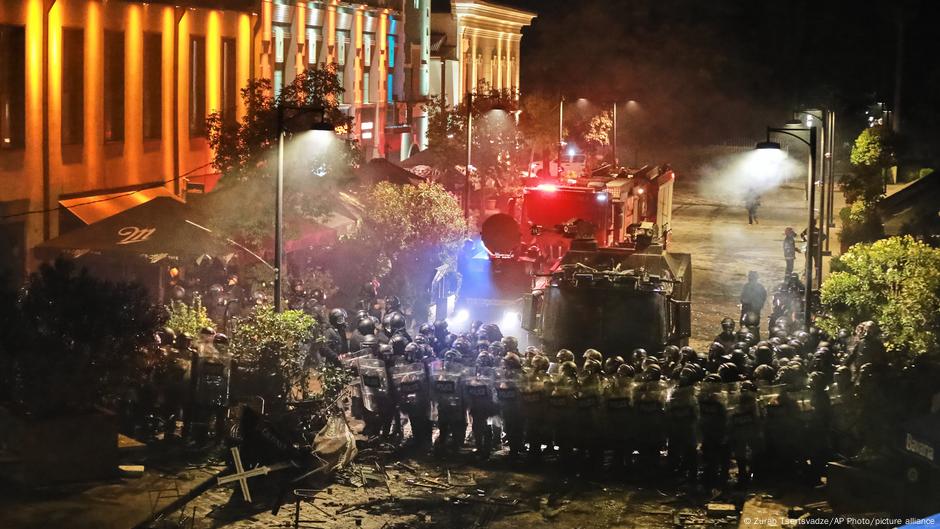
Georgian Prime Minister Irakli Kobakhidze has vowed a crackdown on dissent following significant anti-government protests in Tbilisi, accusing demonstrators of an attempted overthrow and alleging foreign interference, including from the EU. This follows contested local elections and claims of discovered weapons caches for 'subversive acts.' The European Union, however, has strongly rejected these accusations as 'disinformation,' calling for restraint and respect for civil liberties, while highlighting the Georgian government's prior actions that undermined competitive elections. This escalating political tension and diplomatic friction suggest increased instability and potential risks to Georgia's governance and international standing.
Georgia's prime minister promises crackdown on dissent 7 hours agoGeorgian Prime Minister Irakli Kobakhidze on Sunday accused opposition protesters of attempting to overthrow his government and vowed to clamp down on any dissent. Saturday saw tens of thousands of anti-government protesters take to the streets of the capital Tbilisi, many waving Georgian and EU flags. Riot police used water cannons and tear gas to stop them from forcing their way into the presidential palace. Kobakhidze's Georgian Dream party on Saturday claimed victory in every municipality across the country in local elections boycotted by the two main opposition blocs. 'No one will go unpunished,' warns Kobakhidze "Several people have already been arrested — first and foremost the organisers of the attempted overthrow," Kobakhidze told journalists. "No one will go unpunished... many more must expect sentences for the violence they carried out against the state and law enforcement," he added. Among those arrested was world-renowned opera singer and activist Paata Burchuladze. At the rally, he read out a declaration claiming "power returns to the people" and branded the government "illegitimate." On Sunday evening, Georgia's State Security Service (SSS) said a cache of firearms, ammunition and explosives had been discovered in a forest hideout near the capital. Georgian state security said the items were intended for "subversive acts" on election day in concert with organised street violence and an attempt to seize the presidential palace. According to the prime minister, up to 7,000 people attended Saturday's rally, but their "attempt to overthrow the constitutional order" had failed despite what he alleged was support from Brussels. He accused EU Ambassador Pawel Herczynski of interfering in Georgian politics and called on him to condemn the protests. "You know that specific people from abroad have even expressed direct support for all this, for the announced attempt to overthrow the constitutional order," Interpress cited Kobakhidze as saying. EU rejects 'disinformation' and calls for calm EU foreign policy chief Kaja Kallas issued a statement in which she said the EU "firmly rejects and condemns the disinformation regarding the EU's role in Georgia and denounces the personal attacks against the ambassador of the European Union to Georgia." "Months of raids on independent media, the passing of laws targeting civil society, the jailing of opponents and activists or amendments to the electoral code favouring the ruling party, drastically reduced the possibility of having competitive elections," the EU statement said. In the statement, Kallas went on to call for restraint on the part of Georgian authorities. "We urge calm and restraint in the post-election period and call on the authorities to uphold citizens' rights to freedom of assembly and expression," the EU statement said. Edited by: Sean Sinico The political environment in Georgia is deteriorating rapidly, marked by a severe escalation in tensions between the government, domestic opposition, and the European Union. Following local elections boycotted by major opposition blocs, Prime Minister Irakli Kobakhidze has framed large-scale protests as an "attempted overthrow" and pledged a punitive crackdown on dissenters. This narrative is buttressed by state security claims of a discovered weapons cache. Critically, this domestic conflict has triggered a direct diplomatic confrontation with the EU, which has forcefully rejected the Georgian government's accusations of interference as "disinformation" and condemned a series of pre-election actions that it states "drastically reduced the possibility of having competitive elections." The situation, characterized by a "strongly negative" sentiment score (-0.75) and a "volatile" tone, points to a period of heightened instability, increasing Georgia's country risk profile and threatening its relationship with key Western partners.
AI-powered research, real-time alerts, and portfolio analytics for institutional investors.
Request DemoOverall Sentiment
strongly negative
Sentiment Score
-0.75
