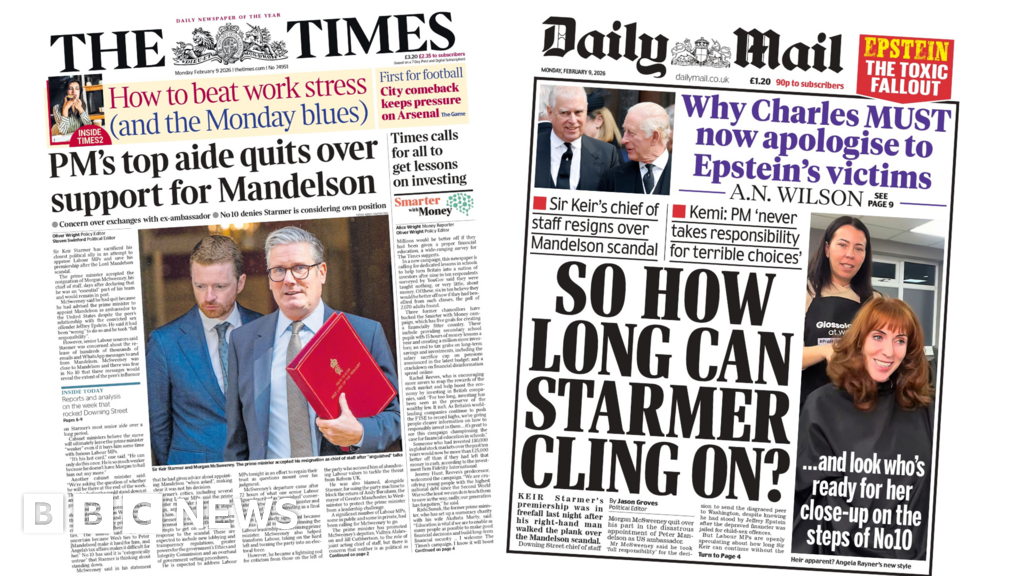
Sir Keir Starmer's chief of staff, Morgan McSweeney, resigned after acknowledging responsibility for advising the prime minister to appoint Lord Mandelson despite Mandelson's known links to Jeffrey Epstein; Mandelson is facing a police probe over alleged misconduct in public office and emails suggesting he leaked sensitive information. The episode has intensified pressure on Starmer from Labour MPs and risks further political instability ahead of a planned internal meeting, representing reputational and governance risks for the government. While not directly tied to economic data or policy, the scandal could weigh on market sentiment and political certainty in the near term.
Market structure: The scandal raises UK domestic political risk premium and favors safe-haven and global-exporter exposures. Expect FTSE 250 and domestically focused mid/small caps to underperform FTSE 100 by ~100–200bps over the next 2–8 weeks as investors reprice governance and policy uncertainty, while multinational large caps (energy, miners) retain pricing power and FX revenues.
Risk assessment: Tail scenarios include a forced PM resignation or snap election (low probability but high impact) that could widen UK 10y gilt yields by 30–80bp and push GBP down >3% in 1–3 months. Hidden dependencies include immigration/border policy shifts affecting services revenue and regulatory plans tied to Starmer’s mandate; key catalysts are police/investigation milestones and a leadership confidence vote within 7–30 days.
Trade implications: Near-term volatility favors tactical FX and equity-relative plays rather than broad directional UK equity exposure. Use 30–90 day instruments to express views (currency options, short-FTSE250/long-global equities pairs); avoid levering core gilt duration unless yields move >20–30bp quickly.
Contrarian angles: Consensus assumes persistent weakness in all UK assets — that is likely overdone for large-cap exporters whose earnings are FX-hedged and globally diversified. If GBP falls >2% and 10y yields rise <40bp, selectively add FTSE 100 exporters (energy/mining) and reduce short positions; historical analogs show political scandals without fiscal shock move indices <5% in 1–3 months.
AI-powered research, real-time alerts, and portfolio analytics for institutional investors.
Request DemoOverall Sentiment
moderately negative
Sentiment Score
-0.50
