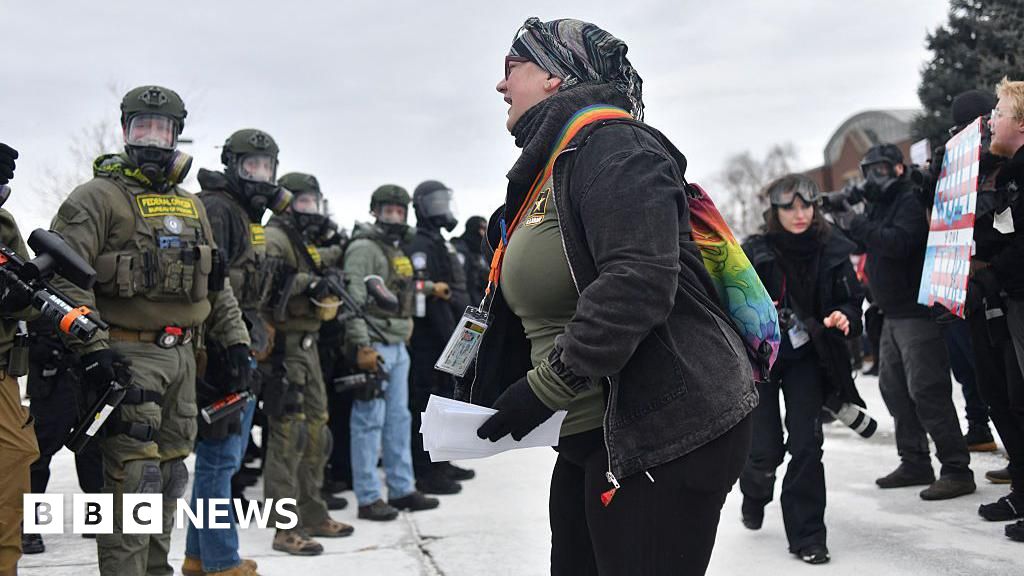
A federal judge issued an 83‑page order restricting ICE agents in Minneapolis from arresting or using pepper spray on "peaceful and unobstructive" protesters and from stopping vehicles without reasonable articulable suspicion, a ruling arising from a December lawsuit and following the Jan. 7 fatal shooting of Renee Good. The decision precedes planned protests, has prompted DHS and White House pushback, led Minnesota to place the National Guard on alert, and coincides with a Justice Department inquiry into state officials — signaling heightened legal and political constraints on federal immigration operations and potential local unrest.
Market structure: The ruling creates a localized tilt toward state/local procurement and private security solutions rather than federal crowd-control vendors. Winners: body-cam/cloud analytics (AXON), data/monitoring firms (PLTR), and defense primes that support National Guard logistics (LHX, LMT)—but expected revenue impact is small (order-of-magnitude <1–2% of revenues for large primes) and concentrated over weeks–months. Losers: niche non-lethal munitions suppliers tied to federal ICE contracts (if publicly exposed) and Minneapolis-focused municipal credit in the near term.
Risk assessment: Tail risks include escalation to prolonged civil unrest causing material local economic disruption and a 20–50bp widening in Minneapolis/Hennepin muni spreads; low probability but high impact over 1–3 months. Immediate effect (days): operational constraints on ICE; short-term (weeks–months): DOJ probes and local procurement shifts; long-term (quarters): potential policy precedent that could re-route federal grants to states. Hidden dependencies: federal funding formulas and state procurement cycles; catalyst set: DOJ report, additional shootings, or a circuit-court stay.
Trade implications: Tactical plays favor small, asymmetric positions: 1–2% longs in AXON and PLTR to capture software/hardware substitution, and 0.5–1% long in LHX or LMT as a defensive hedge against increased Guard deployments. Reduce MN-specific muni exposure by 2–3% of portfolio; expect mean reversion in 3–6 months. Use short-dated (60–120 day) call spreads to limit downside while capturing policy-driven volatility.
Contrarian angle: Markets will likely overstate persistent fiscal damage — historical parallels (local ICE-related unrest in Portland) produced transient credit/political noise with limited long-term fiscal impact. The real alpha is identifying small-cap security tech vendors and state procurement winners before large primes incrementally benefit; watch RFP pipelines and municipal spread moves (>15bp as buy-the-dip trigger). Unintended consequence: tighter federal limits could accelerate private-sector surveillance spend, boosting software vendors more than hardware-makers.
AI-powered research, real-time alerts, and portfolio analytics for institutional investors.
Request DemoOverall Sentiment
neutral
Sentiment Score
0.00
