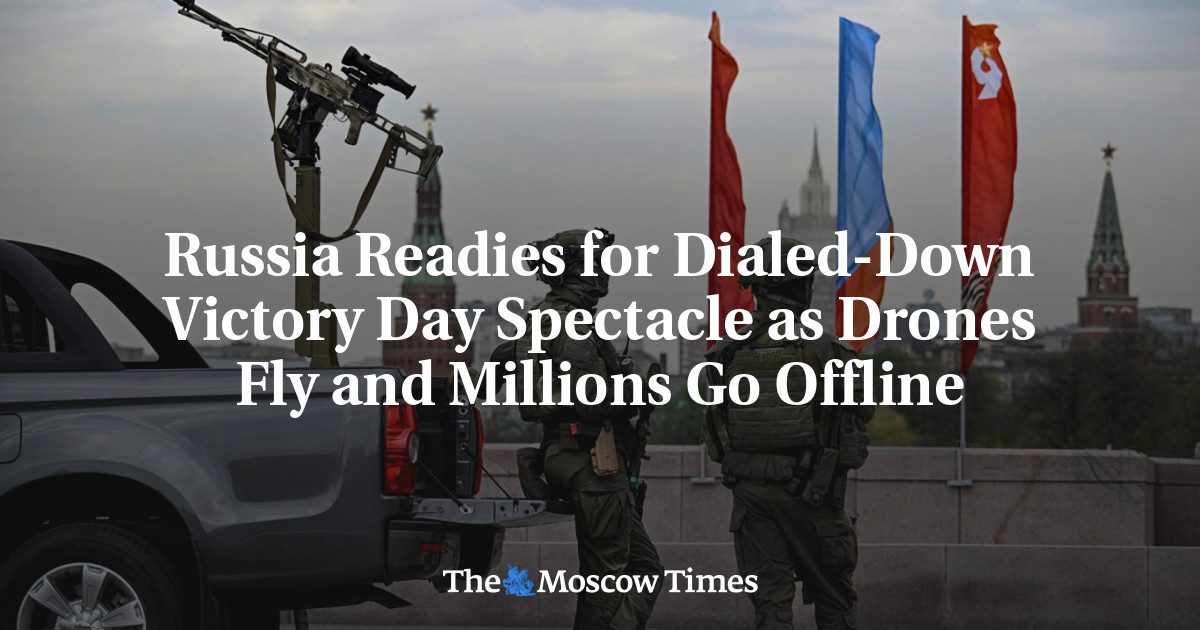
Russia is scaling back Victory Day celebrations, with Moscow's Red Square parade set to proceed without military vehicles for the first time in nearly 20 years and only three world leaders expected to attend. At least 11 regions have canceled public events entirely, while mobile internet outages are expected in 21 regions and drone attacks have already caused deaths in Chuvashia and Crimea. The changes highlight elevated security risks, wartime pressure, and a widening domestic crackdown rather than a market-specific catalyst.
The immediate market read is not about symbolism; it is about regime risk in Russia’s domestic security architecture. When a state scales back its highest-visibility mass event, it signals either elevated threat perception or reduced confidence in coercive control, and both tend to widen the gap between official narrative and operational reality. That matters for Russian risk assets because the Kremlin’s ability to project normalcy has been a key support for domestic confidence, budget execution, and the perceived durability of wartime mobilization.
The second-order effect is a further hardening of the information environment. Rolling internet restrictions around a national holiday are a stress test for digital payments, ride-hailing, logistics dispatch, and local e-commerce; even temporary outages can create merchant-level revenue noise and accelerate adoption of offline contingency systems. The more interesting medium-term implication is that repeated “security” shutdowns normalize control infrastructure, which raises the optionality value of surveillance, telecom filtering, and state-linked cybersecurity vendors while eroding productivity in consumer-facing internet platforms.
For Europe, the key issue is not a near-term escalation tradeable in isolation, but the persistence of a low-grade disruption regime that keeps defense and counter-drone spending elevated across the region. A Russia that is visibly on the defensive domestically is still likely to respond asymmetrically abroad; that supports a higher floor for NATO replenishment cycles, electronic warfare demand, and border security capex over the next 6-18 months. The contrarian view is that markets may overread the optics: parade adjustments could reflect prudence rather than weakness, and unless drone attacks intensify materially, the macro impact should remain mostly local and episodic rather than a broad risk-off catalyst.
AI-powered research, real-time alerts, and portfolio analytics for institutional investors.
Request DemoOverall Sentiment
moderately negative
Sentiment Score
-0.45
