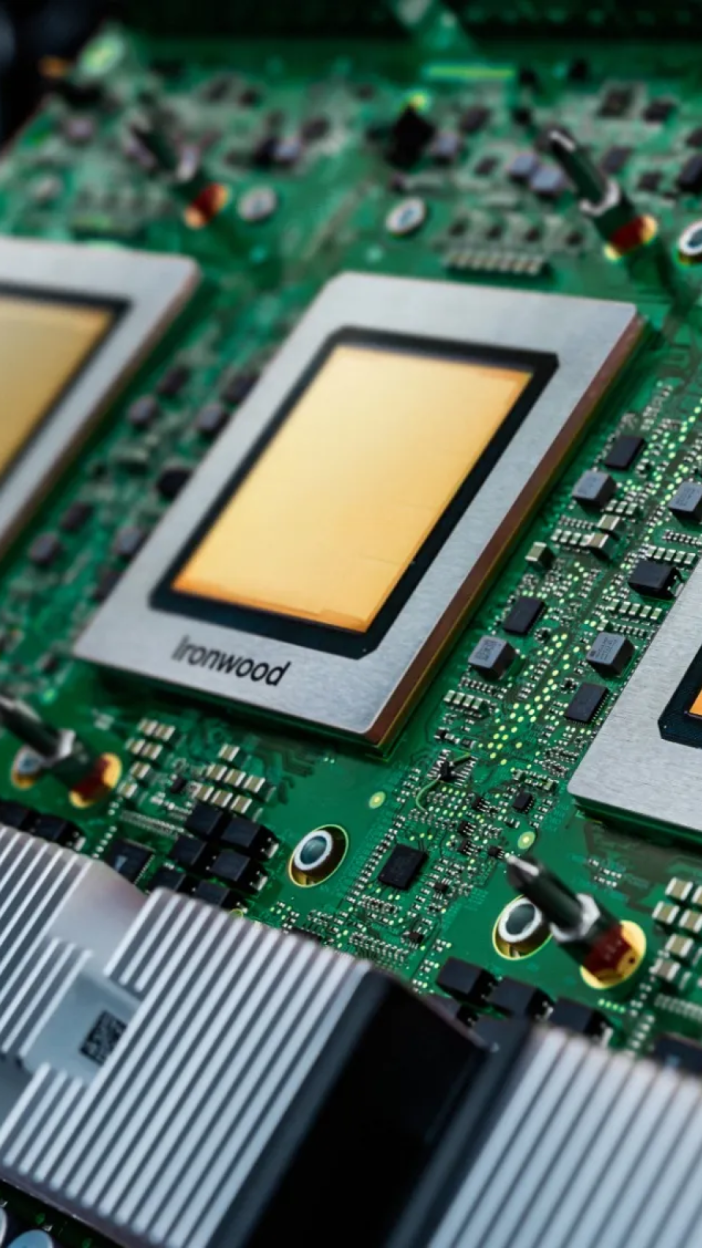
Alphabet has seen its market capitalization rise roughly $1 trillion since mid-October and has overtaken Microsoft to become the world’s third-most valuable company, driven by strong reception to its large-language model Gemini 3 and the strategic advantage of in-house AI chips available via Google Cloud. Reports that Meta may seek access to Google’s chips for use in its datacenters as soon as 2027, and a relative re-rating that leaves NVIDIA trading at ~26x forward earnings versus Alphabet at ~27x, highlight a shifting competitive landscape in AI and semiconductors with meaningful implications for valuations and investor positioning.
Market structure: Alphabet (GOOGL/GOOG) is the immediate winner — its in‑house AI models (Gemini 3) plus proprietary training chips exposed via Google Cloud can reprice raw compute for enterprise AI workloads and capture high‑margin recurring revenue. Direct losers are pure GPU vendors (NVDA) and GPU‑centric cloud resellers if Google’s chips scale; expect pressure on GPU ASPs and incremental cloud compute spend growth assumptions by mid‑2026–2027. Cross‑asset: a durable tech rerating should compress equity implied volatility and marginally tighten IG credit spreads; USD likely to soften on sustained risk‑on, while copper/cooling CAPEX cyclicals benefit over 12–36 months.
Risk assessment: Key tail risks are regulatory/antitrust action on Google’s chip+cloud bundling within 12–24 months, and execution risk that Google chips fail to match NVIDIA on throughput/eco‑system, delaying adoption to 2028+. Near term (days–weeks) moves will be sentiment driven; medium term (3–12 months) fundamentals and product benchmarks matter; long term (2–5 years) market share shifts hinge on cloud partnerships and developer tooling. Hidden dependency: NVIDIA’s moat is software (CUDA) — hardware substitution is slower than headlines imply. Catalysts: Google Cloud product launches (next 6–24 months), NVDA earnings cadence, and any regulatory inquiries.
Trade implications: Tactical long GOOGL exposure for 3–9 months to capture cloud monetization: target 2–3% portfolio position, take profits at +20% or if forward P/E >35, cut at −12%. Implement a pair: long GOOGL / short NVDA (weight ratio ~1:0.6) sized to be 1.5% net equity risk over 3–9 months to capture relative re‑rating; hedge with 3–6 month NVDA put spreads to cap downside. Rotate away from small cap GPU suppliers into cloud/AI software names; monitor implied vol and add option structures if conviction rises.
Contrarian angles: Consensus underestimates friction — Google chips may be complementary, not substitutive, and developer inertia (CUDA) preserves NVIDIA pricing power longer than markets expect; current re‑rating may be overdone given NVDA still trades at ~26x forward vs GOOGL ~27x but with different growth profiles. Historical parallel: proprietary chips (e.g., AWS/custom silicon) raised competitive stakes but did not eliminate incumbent ecosystems immediately. Unintended consequences include regulatory scrutiny that could slow Google’s go‑to‑market and make the bullish trade two‑to‑four quarters more volatile than anticipated.
AI-powered research, real-time alerts, and portfolio analytics for institutional investors.
Request DemoOverall Sentiment
moderately positive
Sentiment Score
0.45
Ticker Sentiment
